Plot: Just to be safe, trigger warning for suicide.
Where to start? Fred Dawson returns home after 5 years as a P.O.W. His wife and son are still there, though his father has passed away. There's also Johann, a German P.O.W. on a work program of sorts, helping keep the farm going. Fred is having some difficulties adjusting: to the improved food, his frostbitten feet, the fact his son doesn't know him, the fact his son seems very comfortable around Johann.
There's also a teenage boy, Tommy Crooks, who has run away from his father in London and returned to the countryside where he stayed as an evacuee. He's seeking a Sir John and Lady Muriel, but their estate has been turned into a psychiatric hospital. Still, one of the doctors, a Josef Novak, is able to direct him to their cottage. Novak has his own concerns. One of his patients, a Peter Phelps, is struggling with the results of his work as a bombardier. The fate of Novak's wife and daughter is also weighing on his mind, as he confides to one of his chess pupils, Foyle. Novak was in Paris for a conference when Hitler invaded Poland. The last he heard, they were transferred from a ghetto to a place called Majdanek.
Also at the hospital is a Dr. Worth, but he won't be there long, as he's received an appointment at Cambridge, though no one seems happy for him, or sorry to see him go, least of all the head of the hospital, Dr. Campbell. Or maybe Novak least of all, because while playing chess with Foyle, he reads something in an article Worth published that causes him to leap from his chair snarling, 'I'll kill him!' And then Dr. Worth is found stabbed in his office the next morning.
Foyle begins trying to pull things together, including why Novak suddenly decided Peter should be transferred to an asylum, but then Novak, in the span of ten minutes or so, goes from mildly distracted, to cutting his wrists in the tub. All he can tell Foyle before being rushed to a hospital is that it was what Worth said.
Tommy's father has reached town, but attempts to speak with his son are deflected by Sir John and his shotgun. Fred is growing increasingly angry at Johann's presence, even accusing Rose of infidelity. Johann's attempts to play peacemaker only make things worse, leading Rose to decide they can't have Johann working there any longer. But coming upon the sad farewell only makes Fred angrier, and he tries to attack Johann. When that fails, he almost attacks Rose, but opts to drink heavily instead. Novak has since been released from the hospital, beds being scarce, and returned to work. He's able to help Tommy understand the incident that caused him to run, and even tries to get Foyle to join him for a Bing Crosby picture, but Foyle declines.
In the night, Johann escapes the P.O.W. camp, and is found dead in the river the next morning. And Foyle hadn't even solved Dr. Worth's murder yet, and here's another, seemingly unrelated one. Fortunately there's a witness to this murder, but Tommy Crooks has gone missing again.
Quote of the Episode: Novak - 'No, the point is someone did imagine it and then made it a reality for my family and countless others.'
Does Foyle go fishing? No, it appears he was spending part of his retirement learning chess, though.
Things Sam can do: Track down a boy that doesn't want to be found. No good at picking soccer teams.
Other: Sam and Brooke both like Bing Crosby. Foyle and Milner do not. I'm with Foyle and Milner, myself.
At one point, describing what happened when Tommy ran off, his father says of Tommy, 'He started creating,' and then his dad walloped him one. I have no idea what "creating" means there. He had already mentioned he started a row, then Tommy does whatever that is, and then physical violence. I don't know, shouting, throwing stuff?
There's this whole subplot about picking winners for the World Cup, and some team from Port Vale manages a stunning victory, or something. I dunno, none of it meant a thing to me, but it keeps popping up throughout, and it seems vaguely relevant since Sergeant Brooke compared his and Foyle's methods of choosing as science versus chance, respectively. And that idea comes up more than once.
As it turns out, Sam and Rose are friends, and after Rose's falling out with Fred, she spends the night at Sam's. Then Johann turns up dead. Sam wisely mentions this to Foyle before he questions Rose and Fred, but then Rose tries to lie about the reason why she spent the night at Sam's, which, seemed unwise. Foyle let it pass, but still. I guess it's smarter than Novak saying, "I'll kill him!" right in front of a cop. On the plus side, at least Sam didn't lose another friend like she did Gwen in "War of Nerves".
The difference in how Foyle handles questioning Novak when he's a suspect, versus Fred, was pretty noticeable. Especially since at one point Novak even suggests Foyle is allowing their friendship to interfere in carrying out his duties, and Foyle dismisses the possibility. But he's much more gentle with Novak, who granted had been through a lot. But so had Fred. It's October of 1944 at this stage, and Fred was captured at Dunkirk. That's no picnic, and Foyle's blunt treatment was disappointing.
None of which excuses Fred's behavior towards Rose. No call for nearly hitting her, and though things seem to be better by the end of the episode, I have to wonder about it. Him accusing her of cheating on him, more than once, combined with almost hitting her, would be kind of an ugly phantom in their marriage. I mean, even at the end, when he's acknowledging that the loss of Johann was hard for her, he still asks if anything happened. I understand his anger that while he was a prisoner at the tender mercies of the Nazis, Johann's in England, working on Fred's family farm, playing with Fred's son, getting homecooked food from Rose. That's not a happy realization.
Foyle never seems worried that Novak killed Dr. Worth, and I'm not sure Milner entirely agrees. Which is rare, but you can tell Milner's choosing his words carefully when he talks about Novak around Foyle. The fact the doctor tried to take his own life is suggestion of something to Milner. As it turns out, Majdanek was a concentration camp, and the Worth Novak referred to was an Alexander Worth, a BBC correspondent traveling with the Soviet Army when they liberated Majdanek, and found the horrors that were typical of the Nazis. And then the newsreel that ran with the movie showed footage from Majdanek, which sent Novak into the night, where he encountered Johann, who brusquely knocked him down and shouted at him in German. And, as Brooke puts it to Sam at one point, Robert's your father's brother.
Science versus chance. Brooke mentions it, and so does Novak in reference to his life. He argues that he believes in free will, and yet the most influential moments in his life have been by chance. Chance that he was separated from his family when Hitler invaded Poland. Chance that he met his wife at all. Chance that he liked Bing Crosby and Foyle doesn't, because if Foyle had been there, Novak wouldn't have run out into the countryside alone and wouldn't have encountered Johann. But it's still free will, isn't it? Foyle made a choice that he doesn't like Bing Crosby. Novak made a choice to attend that conference. Johann made a choice to try and get back and either see Rose, or find some way to fix things between her and Fred. Hitler made a choice to do the horrendous things he did. It's not that free will doesn't come into play, it's that you can't know what choices other people are making simultaneously with their free will, and how those are going to interact with your choices.
Maybe that's what's frustrating Novak. He's trying to help Peter Phelps come to grips with both his past trauma, and the results of his actions as a bombardier, but he can't tell how choices others make are going to factor in, and he fears that renders all his and Peter's efforts useless. Even people trying to do good can be left doing horrible things to try and stop worse things.
Sunday, January 08, 2017

Saturday, January 07, 2017
What I Bought 1/6/2017 - Part 2
Last two books of 2016! Wrapping up a mini-series, and continuing slowly with an ongoing.
 Atomic Robo: The Temple of Od #5, by Brian Clevinger (writer), Scott Wegener (artist), Anthony Clark (colorist), Jeff Powell (letterer) - I have no idea what those things crawling over Robo are. Mechano-mantises? Scorpions?
Matsuda survived the dynamite, but is glowy green energy goop, with the Spot's portal powers. Which is making it pretty hard for Robo to keep him busy while Dr. Lu tries to shut down the zero-point reactor and divert the meltdown to somewhere outside the universe. But the day is saved, Matsuda mostly dissolves (though the Soviets took whatever is left), Lu dies with his brainchild, the Ghost Bandits extort more money from Robo to get him back to safe territory (because he's too lazy to walk), and Helen and Zheng ride off into the, twilight/sunrise? I don't know, we saw it as Robo's memory and it was in grey tones.
Not one of the stronger Atomic Robo mini-series, frankly. The pacing has just been off in terms of the confrontations with the bad guys. It's hard to pin down what bothers me exactly. I was going to say that I was expecting some point where the heroes sit down and plan out how they're going to stop Matsuda, then try to implement it, and then have to adapt when it goes wrong. But that sort of happened, at least as far as Robo trying to make some plan with the Bandits. Except that scene was more about how neither side understands the other, so they're making their own plan Robo is completely unaware of. It's less building for the climax, more an extended gag. Ultimately, there were parts of the story that needed a little more time to breathe, for effect, and they didn't get it, so everything comes off as rushed and lacking impact. if Helen, Lu, and Zheng get captured, is that supposed to be a big deal? If the Soviets are finally getting involved, is that supposed to be important? Because a lot of it didn't feel important.
Wegener's art was stronger in this issue. Fewer panels where he skimps on the details in faces. Even when he goes with a single dark line or blob for eyes, he does enough with the rest of the face and body language to carry it (and Clevinger knows when there needs to be dialogue or not). That first panel of Robo punching Matsuda was really nice, just a solid, well-drawn image. And Anthony Clark set it up so the panels with Robo and Matsuda are nearly overwhelmed with the green light Matsuda's composed of now, and then that contrasts with the darker colors for the scenes of Helen and Zheng, since they're on separate paths at that point. Once their paths cross, the green shades dominate everything, except the panels for Dr. Lu. There's some of the green, but it never feels as pervasive, even though he's in a room pumping out the same energy as Matsuda. But he's in control of the situation (roughly), so it isn't overwhelming him.
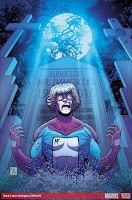 Great Lakes Avengers #3, by Zac Gorman (writer), Will Robson (artist), Tamra Bonvillain (color artist), Joe Caramagna (letterer) - Shouldn't Mr. Immortal's gravestone have a lot more years listed for his deaths?
So Flatman's name is actually Matt, not Val, and he's not a doctor of anything. He originally dressed up as Mr. Fantastic at super-villain parties to get booed (seems like a good way to get disintegrated), but decided to be a super-hero instead. In the present, Councilman Snerd has filed an injunction against the GLA so they can't operate in Detroit. Which doesn't stop the returned Mr. Immortal from insisting he and Flatman go investigate one of the neighborhoods, where they argue about various stuff. For that matter, it doesn't stop Bertha, Doorman, or Good Boy (that is a terrible name) from going to that nightclub, where they discover the villain is also the councilman, passed out drunk on his desk. And Oblivion wants to know why Doorman isn't doing his job, whatever that involves.
I don't know about this, mainly the thing with Flatman. I know the joke about what exactly he's a doctor of has been around for awhile. And there's no reason he can't be a reasonably intelligent guy in some fields other than science. But is the idea the GLA are ultimately a bunch of fakes who hope to become the real thing if they just keep trying long enough? is it going to turn out being middle-of-the-road heroes is the only thing they're actually good at? Mr. Immortal doesn't seem to have anything else going, Flatman clearly wasn't feeling fulfilled as a barista or as a cosplayer for villain parties. Doorman isn't doing a great job for Oblivion by all accounts. Although Bertha had a solid career as a model, so it falls apart there.
The new members of the cast, Good Boy and Pansy (the redhead who had Mr. Immortal's phone and is just kind of hanging around headquarters), they seem OK. It's hard to tell because they haven't really done anything yet. Things are happening, but they seem to be happening around the team, without them being actively involved? The wolfperson, Goodness, seems nice but uncertain of herself, Pansy seems fairly blase about the whole thing. I think it's just a place to crash. I need to see them do something at some critical point to get a better grip on them. I can see Mr. Immortal struggling with alcoholism, since it isn't like it can kill him. Plus the whole thing about being the last being alive at the end of the universe is heavy. He needs to shave though, the stubble thing looks terrible.
Robson's expressions worked better for me this month. Maybe because the attorney wasn't in this issue. She always looked angry beyond what seemed appropriate. Snerd looks extremely angry in one panel, but that's fine, he's a bad guy, he's a demagogue (to the extent a city councilman can be one), he's out to use suffering to enrich himself, it fits. And Good Boy with the sunglasses perched on his(?) nose was a nice visual. He's not doing anything terribly flashy with the layouts, but he tells the story effectively for the most part.
I wonder if Mr. Immortal is going to recruit the drunk guy who puked in front of their Winnebago. That might be something, the GLA as a team of people with no place else to go, the ones being hurt directly by Snerd's bullshit. Or is that what the Occupy Avengers book is doing? Eh, given the casualty rate for the GLA, probably better to keep civilians out of it as much as possible.
 Atomic Robo: The Temple of Od #5, by Brian Clevinger (writer), Scott Wegener (artist), Anthony Clark (colorist), Jeff Powell (letterer) - I have no idea what those things crawling over Robo are. Mechano-mantises? Scorpions?
Matsuda survived the dynamite, but is glowy green energy goop, with the Spot's portal powers. Which is making it pretty hard for Robo to keep him busy while Dr. Lu tries to shut down the zero-point reactor and divert the meltdown to somewhere outside the universe. But the day is saved, Matsuda mostly dissolves (though the Soviets took whatever is left), Lu dies with his brainchild, the Ghost Bandits extort more money from Robo to get him back to safe territory (because he's too lazy to walk), and Helen and Zheng ride off into the, twilight/sunrise? I don't know, we saw it as Robo's memory and it was in grey tones.
Not one of the stronger Atomic Robo mini-series, frankly. The pacing has just been off in terms of the confrontations with the bad guys. It's hard to pin down what bothers me exactly. I was going to say that I was expecting some point where the heroes sit down and plan out how they're going to stop Matsuda, then try to implement it, and then have to adapt when it goes wrong. But that sort of happened, at least as far as Robo trying to make some plan with the Bandits. Except that scene was more about how neither side understands the other, so they're making their own plan Robo is completely unaware of. It's less building for the climax, more an extended gag. Ultimately, there were parts of the story that needed a little more time to breathe, for effect, and they didn't get it, so everything comes off as rushed and lacking impact. if Helen, Lu, and Zheng get captured, is that supposed to be a big deal? If the Soviets are finally getting involved, is that supposed to be important? Because a lot of it didn't feel important.
Wegener's art was stronger in this issue. Fewer panels where he skimps on the details in faces. Even when he goes with a single dark line or blob for eyes, he does enough with the rest of the face and body language to carry it (and Clevinger knows when there needs to be dialogue or not). That first panel of Robo punching Matsuda was really nice, just a solid, well-drawn image. And Anthony Clark set it up so the panels with Robo and Matsuda are nearly overwhelmed with the green light Matsuda's composed of now, and then that contrasts with the darker colors for the scenes of Helen and Zheng, since they're on separate paths at that point. Once their paths cross, the green shades dominate everything, except the panels for Dr. Lu. There's some of the green, but it never feels as pervasive, even though he's in a room pumping out the same energy as Matsuda. But he's in control of the situation (roughly), so it isn't overwhelming him.
 Great Lakes Avengers #3, by Zac Gorman (writer), Will Robson (artist), Tamra Bonvillain (color artist), Joe Caramagna (letterer) - Shouldn't Mr. Immortal's gravestone have a lot more years listed for his deaths?
So Flatman's name is actually Matt, not Val, and he's not a doctor of anything. He originally dressed up as Mr. Fantastic at super-villain parties to get booed (seems like a good way to get disintegrated), but decided to be a super-hero instead. In the present, Councilman Snerd has filed an injunction against the GLA so they can't operate in Detroit. Which doesn't stop the returned Mr. Immortal from insisting he and Flatman go investigate one of the neighborhoods, where they argue about various stuff. For that matter, it doesn't stop Bertha, Doorman, or Good Boy (that is a terrible name) from going to that nightclub, where they discover the villain is also the councilman, passed out drunk on his desk. And Oblivion wants to know why Doorman isn't doing his job, whatever that involves.
I don't know about this, mainly the thing with Flatman. I know the joke about what exactly he's a doctor of has been around for awhile. And there's no reason he can't be a reasonably intelligent guy in some fields other than science. But is the idea the GLA are ultimately a bunch of fakes who hope to become the real thing if they just keep trying long enough? is it going to turn out being middle-of-the-road heroes is the only thing they're actually good at? Mr. Immortal doesn't seem to have anything else going, Flatman clearly wasn't feeling fulfilled as a barista or as a cosplayer for villain parties. Doorman isn't doing a great job for Oblivion by all accounts. Although Bertha had a solid career as a model, so it falls apart there.
The new members of the cast, Good Boy and Pansy (the redhead who had Mr. Immortal's phone and is just kind of hanging around headquarters), they seem OK. It's hard to tell because they haven't really done anything yet. Things are happening, but they seem to be happening around the team, without them being actively involved? The wolfperson, Goodness, seems nice but uncertain of herself, Pansy seems fairly blase about the whole thing. I think it's just a place to crash. I need to see them do something at some critical point to get a better grip on them. I can see Mr. Immortal struggling with alcoholism, since it isn't like it can kill him. Plus the whole thing about being the last being alive at the end of the universe is heavy. He needs to shave though, the stubble thing looks terrible.
Robson's expressions worked better for me this month. Maybe because the attorney wasn't in this issue. She always looked angry beyond what seemed appropriate. Snerd looks extremely angry in one panel, but that's fine, he's a bad guy, he's a demagogue (to the extent a city councilman can be one), he's out to use suffering to enrich himself, it fits. And Good Boy with the sunglasses perched on his(?) nose was a nice visual. He's not doing anything terribly flashy with the layouts, but he tells the story effectively for the most part.
I wonder if Mr. Immortal is going to recruit the drunk guy who puked in front of their Winnebago. That might be something, the GLA as a team of people with no place else to go, the ones being hurt directly by Snerd's bullshit. Or is that what the Occupy Avengers book is doing? Eh, given the casualty rate for the GLA, probably better to keep civilians out of it as much as possible.
Friday, January 06, 2017
What I Bought 1/6/2017 - Part 1
As you might have guessed, the comics didn't arrive on Thursday. They did arrive today. Interestingly the tracking had said the package arrived at the post office in town Tuesday. Quite why it took three days to get across town, I don't know. Anyway, reviews tonight and reviews tomorrow, and then back on schedule next week.
 Deadman: Dark Mansion of Forbidden Love #2, by Sarah Vaughn (writer), Lan Medina (illustrator), Phil Hester (breakdowns, chapter 4), Jose Villarubia (color artist), Janice Chang (letterer) - I like the layout on that cover. Adelia's face with Boston looming angrily behind and above, and Bernice's face barely visible, both in front of Adelia, but behind Boston, just in different dimensions. And then whatever is there along the spine, the tentacles and eyes in that red and black.
Boston meets Adelia, the spirit that haunts Glencrest. Her connection to the dark shadow is uncertain, as is what precisely happened to her. It involved a knife, though. The two emerge from wherever they were and find Bernice has been scouring the house for clues of what happened. Without much success, so she goes into town to check the library. Which only tells her Adelia went missing the night she and her husband moved into Glencrest. She returns to Glencrest to find Nathan ecstatic that he's finished his book, so they can go back to the city. And he wants to marry her, which seems to cause a freakout in Adelia and she may actually be the dark shadow as well.
Vaughn also includes a lot about Boston Brand recognizing perhaps he isn't as unique a case as he thinks, there's other people with similar experiences. I thought the idea that Brand can't remember how long ago he died was significant. Was it the result of his brief merging with Adelia, who also lacks memories, or a more general statement about spirits? Bernice mentioned something to herself about people fixating on what might have been, and letting it take deep root inside them. Are ghosts so locked in on the possibility if only they hadn't died as they did that it keeps them rooted in one place, and makes them lose track of the truth? It applies to the living as well, of course. I know I struggle not to get stuck looking backward, sometimes all I can do is say to myself, "That's over, you chose something else, deal with it." Hard telling how well that works from the inside. Also I wonder what Bernice's "If only. . ." is, or maybe what it will be, pending her decision on Nathan's proposal.
Medina's art comes up a bit short when it needs to depict more extreme amounts of motion of energy. When the shadow emerges at the end of the issue, and everything is flying about, the imagery doesn't have much impact. The characters' body language is more restrained than it feels it ought to be; I get the sense of what is supposed to be conveyed, but I feel I'm filling in the gaps a lot. Also, there's a point where Adelia and Boston can't follow Bernice into her room because of a barrier, but as Boston explains this, we clearly see him sticking his fingers through the barrier. If there was a sense he was in pain, or struggling to do so, that would be one thing, but that isn't the case. It looks more as though the barrier was meant to keep them out, but they're in the process of discovering it doesn't work.
That said, Medina does quite well in giving that sense of Boston and Adelia as spirits. The times we see them floating in a doorway or window, watching quietly evokes some image I associate with spirits. Approaching a spooky house and seeing someone in an upstairs window watching you, but not finding them when you go inside, that kind of thing. There was a book I reread in elementary school, Christina's Ghost, it used that I think. I loved that book back in the day. It and The Two Moons of Mars, I read those multiple times up through 6th grade. Back to Medina's art. Deadman is drawn in such a way that even when he's close to another character, there's some sort of distance. There's a disconnect, even with another ghost. Typically floating above and behind Bernice. The way his face goes into shadow when Adelia shouts out that she was murdered, we know he suffered the same fate, but it's curious Medina opts to obscure his face, rather than depict sorrow, or some sense of commiseration.
When Bernice and Sam return to Glencrest, the sun is setting behind it somewhere, with yellow near the horizon, and red higher up. Inside the house, when Nathan proposes, there's a window behind them, and there's still a bit of red and yellow near the top, but blues and greens, cooler colors lower. The red is up where Adelia is floating, the blue and green down with Nathan and Bernice. Presaging Adelia's strong reaction, and some level of indifference on Bernice's part?
Now I have to wait until next month for the conclusion. I don't know if Vaughn and Medina will stick the landing, whatever that would look like, but I'm cautiously optimistic.
 Deadman: Dark Mansion of Forbidden Love #2, by Sarah Vaughn (writer), Lan Medina (illustrator), Phil Hester (breakdowns, chapter 4), Jose Villarubia (color artist), Janice Chang (letterer) - I like the layout on that cover. Adelia's face with Boston looming angrily behind and above, and Bernice's face barely visible, both in front of Adelia, but behind Boston, just in different dimensions. And then whatever is there along the spine, the tentacles and eyes in that red and black.
Boston meets Adelia, the spirit that haunts Glencrest. Her connection to the dark shadow is uncertain, as is what precisely happened to her. It involved a knife, though. The two emerge from wherever they were and find Bernice has been scouring the house for clues of what happened. Without much success, so she goes into town to check the library. Which only tells her Adelia went missing the night she and her husband moved into Glencrest. She returns to Glencrest to find Nathan ecstatic that he's finished his book, so they can go back to the city. And he wants to marry her, which seems to cause a freakout in Adelia and she may actually be the dark shadow as well.
Vaughn also includes a lot about Boston Brand recognizing perhaps he isn't as unique a case as he thinks, there's other people with similar experiences. I thought the idea that Brand can't remember how long ago he died was significant. Was it the result of his brief merging with Adelia, who also lacks memories, or a more general statement about spirits? Bernice mentioned something to herself about people fixating on what might have been, and letting it take deep root inside them. Are ghosts so locked in on the possibility if only they hadn't died as they did that it keeps them rooted in one place, and makes them lose track of the truth? It applies to the living as well, of course. I know I struggle not to get stuck looking backward, sometimes all I can do is say to myself, "That's over, you chose something else, deal with it." Hard telling how well that works from the inside. Also I wonder what Bernice's "If only. . ." is, or maybe what it will be, pending her decision on Nathan's proposal.
Medina's art comes up a bit short when it needs to depict more extreme amounts of motion of energy. When the shadow emerges at the end of the issue, and everything is flying about, the imagery doesn't have much impact. The characters' body language is more restrained than it feels it ought to be; I get the sense of what is supposed to be conveyed, but I feel I'm filling in the gaps a lot. Also, there's a point where Adelia and Boston can't follow Bernice into her room because of a barrier, but as Boston explains this, we clearly see him sticking his fingers through the barrier. If there was a sense he was in pain, or struggling to do so, that would be one thing, but that isn't the case. It looks more as though the barrier was meant to keep them out, but they're in the process of discovering it doesn't work.
That said, Medina does quite well in giving that sense of Boston and Adelia as spirits. The times we see them floating in a doorway or window, watching quietly evokes some image I associate with spirits. Approaching a spooky house and seeing someone in an upstairs window watching you, but not finding them when you go inside, that kind of thing. There was a book I reread in elementary school, Christina's Ghost, it used that I think. I loved that book back in the day. It and The Two Moons of Mars, I read those multiple times up through 6th grade. Back to Medina's art. Deadman is drawn in such a way that even when he's close to another character, there's some sort of distance. There's a disconnect, even with another ghost. Typically floating above and behind Bernice. The way his face goes into shadow when Adelia shouts out that she was murdered, we know he suffered the same fate, but it's curious Medina opts to obscure his face, rather than depict sorrow, or some sense of commiseration.
When Bernice and Sam return to Glencrest, the sun is setting behind it somewhere, with yellow near the horizon, and red higher up. Inside the house, when Nathan proposes, there's a window behind them, and there's still a bit of red and yellow near the top, but blues and greens, cooler colors lower. The red is up where Adelia is floating, the blue and green down with Nathan and Bernice. Presaging Adelia's strong reaction, and some level of indifference on Bernice's part?
Now I have to wait until next month for the conclusion. I don't know if Vaughn and Medina will stick the landing, whatever that would look like, but I'm cautiously optimistic.
Wednesday, January 04, 2017
Island of the Lost - Joan Druett
UPS and the Postal Service have failed to get the comics I ordered here by today. So you get the post I had planned for Thursday instead. Hopefully the comics will have shown up by tomorrow.
In October 1864, two different ships wrecked on the Auckland Islands south of New Zealand. Francois Raynal and Thomas Musgrave led the Grafton, with a crew of three under them to those islands, hoping to at least bring some seal pelts home after a wasted trip to the Campbell Islands searching for a vein of tin that might have silver. The five men survived the wreck, but found themselves in a fairly inhospitable location. Fortunately, they were able to salvage quite a lot of supplies from their ship, and pulled together to survive.
The Invercauld wrecked a few months later. There were 19 men on the ship, but there was very little that could be saved from the ship. The crew utterly failed to pull together, the captain and his mates sat around in a stupor (and probably killed two of their cabin boys by making them constantly fetch water and food rather than, you know, get off their lazy asses and do it themselves), and most of them died. The two groups of castaways were 20 miles apart and completely unaware of each other.
Druett starts with the Grafton's story, and then, once the Invercauld wrecks, begins moving back and forth between the groups as times passes. Even then, I think there's more focus on the Grafton, but that may be owing to Musgrave and Raynal both doing better keeping logbooks and records of their experiences, both of which were later turned into books. Also, Captain Dalgarno's accounts of what happened to the Invercauld's crew contradict those of his mate Andrew Smith, and Robert Holding, the seaman who did most of the work keeping anyone alive. these various excerpts are interesting enough, but Druett's an effective descriptive writer, explaining discrepancies or helping the reader to understand challenges the crews faced the journals don't expand on, or misunderstood. The descriptions of the landscape are excellent, although I don't know if Druett intends for me to want to visit the islands. I don't want to live there mind you, just go and see them.
Mostly, I was impressed by the ingenuity of the crew. Building a house with a stone chimney out of the twisted, bent trees on the island is impressive enough. But Raynal figures out how to make soap from the ingredients at hand, constructs bellows and a forge to make nails and some basic tools, figures out a way to turn seal pelts into actually worthwhile shoes. That was pretty impressive to me, as was the fact that, even if they thought some of the ideas were farfetched (like the soap) the other four men were willing to pick up the slack on collecting firewood or hunting while he did that. But that cooperation is the key for the Grafton's crew. Early on, there's a noted sense that the three crewmen don't appreciate taking orders From Musgrave so much now that they're stranded. So they decide to take nominations for leader. Raynal nominates Musgrave, and the others readily agree. So Musgrave is still in charge, but now the men feel they got a say in it, and that helps smooth things over.
'When the sounds of their voices had faded, there were other noises - the hiss and thud of the sea, the cries of restless birds, the pattering of rain, and the rustle and crack of windblown branches - but behind it all lay an oppressive silence, a preternatural awareness of complete and dreadful isolation.'
In October 1864, two different ships wrecked on the Auckland Islands south of New Zealand. Francois Raynal and Thomas Musgrave led the Grafton, with a crew of three under them to those islands, hoping to at least bring some seal pelts home after a wasted trip to the Campbell Islands searching for a vein of tin that might have silver. The five men survived the wreck, but found themselves in a fairly inhospitable location. Fortunately, they were able to salvage quite a lot of supplies from their ship, and pulled together to survive.
The Invercauld wrecked a few months later. There were 19 men on the ship, but there was very little that could be saved from the ship. The crew utterly failed to pull together, the captain and his mates sat around in a stupor (and probably killed two of their cabin boys by making them constantly fetch water and food rather than, you know, get off their lazy asses and do it themselves), and most of them died. The two groups of castaways were 20 miles apart and completely unaware of each other.
Druett starts with the Grafton's story, and then, once the Invercauld wrecks, begins moving back and forth between the groups as times passes. Even then, I think there's more focus on the Grafton, but that may be owing to Musgrave and Raynal both doing better keeping logbooks and records of their experiences, both of which were later turned into books. Also, Captain Dalgarno's accounts of what happened to the Invercauld's crew contradict those of his mate Andrew Smith, and Robert Holding, the seaman who did most of the work keeping anyone alive. these various excerpts are interesting enough, but Druett's an effective descriptive writer, explaining discrepancies or helping the reader to understand challenges the crews faced the journals don't expand on, or misunderstood. The descriptions of the landscape are excellent, although I don't know if Druett intends for me to want to visit the islands. I don't want to live there mind you, just go and see them.
Mostly, I was impressed by the ingenuity of the crew. Building a house with a stone chimney out of the twisted, bent trees on the island is impressive enough. But Raynal figures out how to make soap from the ingredients at hand, constructs bellows and a forge to make nails and some basic tools, figures out a way to turn seal pelts into actually worthwhile shoes. That was pretty impressive to me, as was the fact that, even if they thought some of the ideas were farfetched (like the soap) the other four men were willing to pick up the slack on collecting firewood or hunting while he did that. But that cooperation is the key for the Grafton's crew. Early on, there's a noted sense that the three crewmen don't appreciate taking orders From Musgrave so much now that they're stranded. So they decide to take nominations for leader. Raynal nominates Musgrave, and the others readily agree. So Musgrave is still in charge, but now the men feel they got a say in it, and that helps smooth things over.
'When the sounds of their voices had faded, there were other noises - the hiss and thud of the sea, the cries of restless birds, the pattering of rain, and the rustle and crack of windblown branches - but behind it all lay an oppressive silence, a preternatural awareness of complete and dreadful isolation.'
Tuesday, January 03, 2017
The Hateful Eight (2015)
The Hateful Eight was on TV, so I tried watching it. I wouldn't describe myself as a Tarantino fan, but I've enjoyed some of his work. This is, probably not going to be one of those films.
Kurt Russell is a bounty hunter bringing in Daisy Domergue (Jennifer Jason Leigh), a woman with a 10,000 bounty on her head. The wagon stops to pick up Samuel L. Jackson and Walton Goggins*, the former another bounty hunter, the other soon to be sheriff of the town Russell is delivering Daisy to. A storm forces the wagon to stay over at a way station. The normal proprietors are oddly absent, but there are four other people there riding out the storm. At some point, after a lot of talking, and cursing, and more talking, and various characters punching Daisy in the face for the temerity of speaking, and more talking, people start dying. Then there's a 20-minute flashback, then the conclusion.
So yeah, I got a little bored with all the talking. It's possible to use people sitting and talking to increase the tension, the anticipation of the moment when something will happen (or even without talking, see Leone, Sergio). Here, it's dragged out too long, and there's so much talking it just gets tiring after awhile. Kurt Russell is complaining they need to stay ahead of the blizzard, but then wastes an inordinate amount of time arguing with Jackson about whether he'll help load bounty corpses on the wagon.
Also, and maybe this was just me, but there was a disconnect between the dialogue and the violence. The violence seems almost cartoonish is the level of gore, Samuel L. Jackson unloading two pistols into a guy's face, and said face ceasing to exist. Or the protracted vomiting blood sequence, which started to remind me of that Family Guy scene where a bunch of the characters drink ipecac to see who can go the longest without vomiting, only to experience awful consequences. But that doesn't seem like what the dialogue is going for. The characters may be deluding themselves about their pasts and the justifications for their actions, but I don't think they're supposed to be comical.
I'm not sure if I was supposed to enjoy watching them die. I was mostly relived something was happening, and secondary to that, I laughed at some of the violence. But the characters largely failed to make me care enough about them one way or the other. Except maybe for Daisy, and that wasn't really anything achieved by her sparkling personality. Mostly just because all the guys seemed to punch her for any little thing. She doesn't deny being part of a gang, so she had certainly done some shitty things to earn a $10,000 bounty, so no a good person by any stretch. But as she doesn't have much opportunity to fight back, my sympathies leaned slightly towards her. Not much, but a little. Certainly at the end, when Goggins and Jackson share a good chuckle as they lynch her.
The violence and the dialogue were stylistically what I expect from Tarantino, but they clashed in a way I don't remember in the films of his I've watched in the past. Maybe because he went a little further with both, and reached a point where the two couldn't be reconciled.
* As someone who first saw Goggins on TV in The Shield, it's strange to me to see him now being this sought-after actor with an avid fanbase. I saw a review of some film (American Ultra?) where the person complained of how the movie "wasted" Walton Goggins. Which was not a statement I would have expected to read 10 years ago, and one I still have some trouble buying into.
Kurt Russell is a bounty hunter bringing in Daisy Domergue (Jennifer Jason Leigh), a woman with a 10,000 bounty on her head. The wagon stops to pick up Samuel L. Jackson and Walton Goggins*, the former another bounty hunter, the other soon to be sheriff of the town Russell is delivering Daisy to. A storm forces the wagon to stay over at a way station. The normal proprietors are oddly absent, but there are four other people there riding out the storm. At some point, after a lot of talking, and cursing, and more talking, and various characters punching Daisy in the face for the temerity of speaking, and more talking, people start dying. Then there's a 20-minute flashback, then the conclusion.
So yeah, I got a little bored with all the talking. It's possible to use people sitting and talking to increase the tension, the anticipation of the moment when something will happen (or even without talking, see Leone, Sergio). Here, it's dragged out too long, and there's so much talking it just gets tiring after awhile. Kurt Russell is complaining they need to stay ahead of the blizzard, but then wastes an inordinate amount of time arguing with Jackson about whether he'll help load bounty corpses on the wagon.
Also, and maybe this was just me, but there was a disconnect between the dialogue and the violence. The violence seems almost cartoonish is the level of gore, Samuel L. Jackson unloading two pistols into a guy's face, and said face ceasing to exist. Or the protracted vomiting blood sequence, which started to remind me of that Family Guy scene where a bunch of the characters drink ipecac to see who can go the longest without vomiting, only to experience awful consequences. But that doesn't seem like what the dialogue is going for. The characters may be deluding themselves about their pasts and the justifications for their actions, but I don't think they're supposed to be comical.
I'm not sure if I was supposed to enjoy watching them die. I was mostly relived something was happening, and secondary to that, I laughed at some of the violence. But the characters largely failed to make me care enough about them one way or the other. Except maybe for Daisy, and that wasn't really anything achieved by her sparkling personality. Mostly just because all the guys seemed to punch her for any little thing. She doesn't deny being part of a gang, so she had certainly done some shitty things to earn a $10,000 bounty, so no a good person by any stretch. But as she doesn't have much opportunity to fight back, my sympathies leaned slightly towards her. Not much, but a little. Certainly at the end, when Goggins and Jackson share a good chuckle as they lynch her.
The violence and the dialogue were stylistically what I expect from Tarantino, but they clashed in a way I don't remember in the films of his I've watched in the past. Maybe because he went a little further with both, and reached a point where the two couldn't be reconciled.
* As someone who first saw Goggins on TV in The Shield, it's strange to me to see him now being this sought-after actor with an avid fanbase. I saw a review of some film (American Ultra?) where the person complained of how the movie "wasted" Walton Goggins. Which was not a statement I would have expected to read 10 years ago, and one I still have some trouble buying into.
Monday, January 02, 2017
Summing Up A Year's Worth Of Passing Time
As has become standard, it's a look back at the books, movies, and games I read, watched, or played this year. As always, it's considered new in the sense I hadn't encountered it previously, regardless of when it was produced. If I stuck to things released in 2016, there'd be a sample size of roughly 4.
Not nearly as many books as in past years. I wasn't near many good bookstores, so I didn't randomly purchase many paperbacks, and my dad didn't send as many books my way as usual. Starting with fiction, not a banner year. Most of the books weren't what I was hoping for. Would have expected better results with some of the authors in there, but oh well. To be fair, Eric was a perfectly fine introduction to Terry Prachett's works. But Focault's Pendulum is going to walk away with least favorite, since it was the one I couldn't even bother to finish. I don't care about Templars, and Umberto Eco couldn't make me, no matter how many pages he devoted to them. Red Winter is going to wind up as favorite. I enjoyed it the most while I was reading it, even if the ending was slightly more upbeat than I expected. In that I expected everyone to die, and a few people survived. It wasn't world-changing, but the atmosphere of it, the sense of most of the population being crushed by something terrible they can't figure out how to stop, and are too afraid of being destroyed by to talk openly with anyone.
I feel I should have said The Brothers Karamazov, and I wasn't disappointed by that book. Actually, I was worried about it being a letdown, the victim of too many expectations (and the fact I don't always love 19th Century writing), but that didn't happen. It was extremely engaging at times, but other parts were overly long and dragged it to a crawl. Those were undoubtedly vitally important to Dostoyevsky, but they did diminish my enjoyment of the book.
On the nonfiction side, much of it is in the World War 2 or interwar period, like most of the previous two years' nonfiction. I was at least able to branch out somewhat. A few books on Meiji Japan, some books on specific presidential elections. Much of it is depressing, as history often is, but at least it's also often informative.
On the positive side, The Lost City of Z was solid, and The Arsenal of Democracy taught me a lot about Edsel Ford. He's not a subject I'd have expected to be interested in, but wound up being compelling as a figure trying to do his best against limitations his dad had imposed on him in various ways and for various reasons. But they're on the tier below the top. Candice Millard's Destiny of the Republic would be in the top 3. It doesn't seem like a book about President Garfield, Alexander Graham Bell, and the American medical industry's resistance to basic hygiene would be able to come together, but it did. I've read other books like that, where you can tell the author just didn't have enough on one topic for an entire book, so they try to draw loose connections to a couple of other things to pad it out. But Millard takes the particular circumstances and runs with it. The other two would be David Pietrusza's The Year of Six Presidents, which was funny, informative, and ultimately depressing in how Warren G. Harding ends up as President, and Tim Tzouliadis' The Forsaken. That one was just depressing, and infuriating, but sometimes it's good to remember the horrors people can inflict on each other, just as a reminder. 2016: The year Calvin found a lot of interest in reading about Russia! Of all of them, I think that's the one that's stuck with me the most (it's a little weird going over the book posts and going, "Oh yeah, I did read that.")
As for least favorite, there were a lot of books that trod familiar ground for me. John Ellis' Brute Force for one. Also Richard Overy's The Bombing War, although there was a lot of good information in that one (probably too much, you can get bogged down under all the figures). The Friar and the Cipher was one of those books with not enough on one subject to fill a whole book I mentioned above. The same could be said of The Man Who Didn't Shoot Hitler, just because there was so little on Tandey's life available. I'd pick The Long Shadow as least favorite. I expected something a little more wide-ranging in terms of how different countries were impacted by the First World War, and instead it was focused almost entirely on England. Credit for delving into its impact on poetry over the decades I suppose, but not my bag.
More movies than the last couple years. Combination of my dad and I apparently watching a lot of stuff, and also one of my housemates over the summer deciding they couldn't live without a complete TV package, meaning movie channels. Otherwise I probably still wouldn't have seen Ant-Man, not to mention The Stanford Prison Experiment, probably a few other things.
Look, we all know what I'm going to pick as my favorite movie. I know it had its flaws, certain gaps in logic, but it was still very funny, so congratulations Remember the Night.
No, no, I'm joking, it's Deadpool. The only movie I made it a point to go see, that left me so pumped up I happily ran across the parking lot afterward. A movie that actually has me looking forward to seeing Cable in the sequel. Credit for that Herculean effort, if nothing else.
Other movies I enjoyed, sure Remember the Night would be on there. Better than I expected. The Heiress, for the last half-hour when Olivia de Havilland's character starts verbally destroying fools. Maggie was solid, Mad Max: Fury Road was very good, although I don't love it as much as the people who freak out about it. I reserve that for Deadpool, obviously. Fury Road was an extremely pretty movie, especially the sequence with the sandstorm. I liked Return of Sabata the most of the three Sabata films, because it was the one they seemed to be having the most fun with. In some cases, a film fully embracing how absurd it's being works really well with me (see also: Crank). Speaking of Jason Statham, Spy was pretty funny. I'm generally indifferent to Melissa McCarthy; certainly most of the movies she's been in the last few years didn't look good to me (I think I liked Heat all right, but I tend to be a Sandra Bullock fan), but I really enjoyed this one, so cheers.
What about the bad? No shortage of options here. You may be surprised to learn Batman v Superman will not be taking the prize. I have no love for it, but I guess my expectations were set low enough by it being a Zack Snyder film that it might have struggled to be horrible enough to really bother me. I expected it would be dark and grim, and it was. The main thing that stood out is Jesse Eisenberg as Luthor, and that's because he's fucking terrible. I'm almost inclined to give it to Ratchet & Clank, which made no impression whatsoever, but I'll just accept that film was Not For Me. It wasn't bad, it was just there. Paint by numbers.
I doubt I saw enough of Jurassic World to assess it. Fantastic Four was a mess. I didn't like Red Dust when I watched it years ago as Mogambo, and I didn't like it here. Wife vs. Secretary hinged on such a stupid decision by Clark Gable's character it ruined the whole thing for me. But I'll give it to The Monster. Maybe it should be Sausage Party, but I did laugh once during that movie, so as a comedy, it succeeded? Barely. Let's hear it for low expectations! The Monster was a horror flick that really wanted to be about alcoholism. The monster was there to break up the monotonous flashbacks. Every other film had at least one moment, joke, visual, scene, something that I liked. This one drove me to bed.
Not a lot to choose from this year. I kind of want to pick Tales of Vesperia again. I played through it a second time in the spring, to try and pick up a lot of the secondary quests I missed the first time through, which is rare for me with JRPGs. I really enjoyed it, maybe more than the first time, since I understood the mechanics better, but that feels like a cheat. I don't know.
There was the Batman game from Telltale, the one that's nothing but dialogue scenes and quick-time events? The 2013 Tomb Raider, Thief, Deus Ex: Human Revolution. There was a Hitman game as part of the stealth triple pack. I gave up on that before I finished the tutorial. I tried a couple of demos through XBox Live Arcade, but the only ones I actually bought were Half-Minute Hero and Marvel Puzzle Quest. I've spent more time than I should on the latter, considering how much I have to go back and replay the same levels over and over to level my characters up enough to win in the next level. Not to mention even just progressing through the story requires you "fight" the same villains over and over again. I think I've beaten Daken 47 times already. A friend sent me Skyrim, and I've been playing that off and on since June, depending on how much it's annoying me. I'll get to reviewing it eventually, since I think I'm nearing the end with it.
Thief was a glitchy mess, Deus Ex had boss fights which ran completely counter to how the rest of the game plays out. And the writing was crap. I mentioned this is my review, but there are a dozen things you can pick up and read during the game that strongly hint or outright tell you a particular character isn't dead, and even if you read all of them, Adam still reacts with complete surprise when he sees the character alive. Plus that whole thing where you can't hack computers and stay crouched. God that was bullshit.
Let's go with Tomb Raider. The game mostly did what it wanted to well, and it wasn't glitchy. There were definitely times it was very fun, and a few points that were kind of scary, which I wasn't expecting. The scary parts didn't necessarily pay of in the end, but in the moment they worked. I would have preferred a little more tomb raiding, less of the gunfights that go on forever. They include all these little Easter eggs to encourage us to explore, but I found myself hesitant because I didn't want to spend five minutes fending off waves of bad guys just to find a vase or a GPS waypoint.
Books
Not nearly as many books as in past years. I wasn't near many good bookstores, so I didn't randomly purchase many paperbacks, and my dad didn't send as many books my way as usual. Starting with fiction, not a banner year. Most of the books weren't what I was hoping for. Would have expected better results with some of the authors in there, but oh well. To be fair, Eric was a perfectly fine introduction to Terry Prachett's works. But Focault's Pendulum is going to walk away with least favorite, since it was the one I couldn't even bother to finish. I don't care about Templars, and Umberto Eco couldn't make me, no matter how many pages he devoted to them. Red Winter is going to wind up as favorite. I enjoyed it the most while I was reading it, even if the ending was slightly more upbeat than I expected. In that I expected everyone to die, and a few people survived. It wasn't world-changing, but the atmosphere of it, the sense of most of the population being crushed by something terrible they can't figure out how to stop, and are too afraid of being destroyed by to talk openly with anyone.
I feel I should have said The Brothers Karamazov, and I wasn't disappointed by that book. Actually, I was worried about it being a letdown, the victim of too many expectations (and the fact I don't always love 19th Century writing), but that didn't happen. It was extremely engaging at times, but other parts were overly long and dragged it to a crawl. Those were undoubtedly vitally important to Dostoyevsky, but they did diminish my enjoyment of the book.
On the nonfiction side, much of it is in the World War 2 or interwar period, like most of the previous two years' nonfiction. I was at least able to branch out somewhat. A few books on Meiji Japan, some books on specific presidential elections. Much of it is depressing, as history often is, but at least it's also often informative.
On the positive side, The Lost City of Z was solid, and The Arsenal of Democracy taught me a lot about Edsel Ford. He's not a subject I'd have expected to be interested in, but wound up being compelling as a figure trying to do his best against limitations his dad had imposed on him in various ways and for various reasons. But they're on the tier below the top. Candice Millard's Destiny of the Republic would be in the top 3. It doesn't seem like a book about President Garfield, Alexander Graham Bell, and the American medical industry's resistance to basic hygiene would be able to come together, but it did. I've read other books like that, where you can tell the author just didn't have enough on one topic for an entire book, so they try to draw loose connections to a couple of other things to pad it out. But Millard takes the particular circumstances and runs with it. The other two would be David Pietrusza's The Year of Six Presidents, which was funny, informative, and ultimately depressing in how Warren G. Harding ends up as President, and Tim Tzouliadis' The Forsaken. That one was just depressing, and infuriating, but sometimes it's good to remember the horrors people can inflict on each other, just as a reminder. 2016: The year Calvin found a lot of interest in reading about Russia! Of all of them, I think that's the one that's stuck with me the most (it's a little weird going over the book posts and going, "Oh yeah, I did read that.")
As for least favorite, there were a lot of books that trod familiar ground for me. John Ellis' Brute Force for one. Also Richard Overy's The Bombing War, although there was a lot of good information in that one (probably too much, you can get bogged down under all the figures). The Friar and the Cipher was one of those books with not enough on one subject to fill a whole book I mentioned above. The same could be said of The Man Who Didn't Shoot Hitler, just because there was so little on Tandey's life available. I'd pick The Long Shadow as least favorite. I expected something a little more wide-ranging in terms of how different countries were impacted by the First World War, and instead it was focused almost entirely on England. Credit for delving into its impact on poetry over the decades I suppose, but not my bag.
Movies
More movies than the last couple years. Combination of my dad and I apparently watching a lot of stuff, and also one of my housemates over the summer deciding they couldn't live without a complete TV package, meaning movie channels. Otherwise I probably still wouldn't have seen Ant-Man, not to mention The Stanford Prison Experiment, probably a few other things.
Look, we all know what I'm going to pick as my favorite movie. I know it had its flaws, certain gaps in logic, but it was still very funny, so congratulations Remember the Night.
No, no, I'm joking, it's Deadpool. The only movie I made it a point to go see, that left me so pumped up I happily ran across the parking lot afterward. A movie that actually has me looking forward to seeing Cable in the sequel. Credit for that Herculean effort, if nothing else.
Other movies I enjoyed, sure Remember the Night would be on there. Better than I expected. The Heiress, for the last half-hour when Olivia de Havilland's character starts verbally destroying fools. Maggie was solid, Mad Max: Fury Road was very good, although I don't love it as much as the people who freak out about it. I reserve that for Deadpool, obviously. Fury Road was an extremely pretty movie, especially the sequence with the sandstorm. I liked Return of Sabata the most of the three Sabata films, because it was the one they seemed to be having the most fun with. In some cases, a film fully embracing how absurd it's being works really well with me (see also: Crank). Speaking of Jason Statham, Spy was pretty funny. I'm generally indifferent to Melissa McCarthy; certainly most of the movies she's been in the last few years didn't look good to me (I think I liked Heat all right, but I tend to be a Sandra Bullock fan), but I really enjoyed this one, so cheers.
What about the bad? No shortage of options here. You may be surprised to learn Batman v Superman will not be taking the prize. I have no love for it, but I guess my expectations were set low enough by it being a Zack Snyder film that it might have struggled to be horrible enough to really bother me. I expected it would be dark and grim, and it was. The main thing that stood out is Jesse Eisenberg as Luthor, and that's because he's fucking terrible. I'm almost inclined to give it to Ratchet & Clank, which made no impression whatsoever, but I'll just accept that film was Not For Me. It wasn't bad, it was just there. Paint by numbers.
I doubt I saw enough of Jurassic World to assess it. Fantastic Four was a mess. I didn't like Red Dust when I watched it years ago as Mogambo, and I didn't like it here. Wife vs. Secretary hinged on such a stupid decision by Clark Gable's character it ruined the whole thing for me. But I'll give it to The Monster. Maybe it should be Sausage Party, but I did laugh once during that movie, so as a comedy, it succeeded? Barely. Let's hear it for low expectations! The Monster was a horror flick that really wanted to be about alcoholism. The monster was there to break up the monotonous flashbacks. Every other film had at least one moment, joke, visual, scene, something that I liked. This one drove me to bed.
Video Games
Not a lot to choose from this year. I kind of want to pick Tales of Vesperia again. I played through it a second time in the spring, to try and pick up a lot of the secondary quests I missed the first time through, which is rare for me with JRPGs. I really enjoyed it, maybe more than the first time, since I understood the mechanics better, but that feels like a cheat. I don't know.
There was the Batman game from Telltale, the one that's nothing but dialogue scenes and quick-time events? The 2013 Tomb Raider, Thief, Deus Ex: Human Revolution. There was a Hitman game as part of the stealth triple pack. I gave up on that before I finished the tutorial. I tried a couple of demos through XBox Live Arcade, but the only ones I actually bought were Half-Minute Hero and Marvel Puzzle Quest. I've spent more time than I should on the latter, considering how much I have to go back and replay the same levels over and over to level my characters up enough to win in the next level. Not to mention even just progressing through the story requires you "fight" the same villains over and over again. I think I've beaten Daken 47 times already. A friend sent me Skyrim, and I've been playing that off and on since June, depending on how much it's annoying me. I'll get to reviewing it eventually, since I think I'm nearing the end with it.
Thief was a glitchy mess, Deus Ex had boss fights which ran completely counter to how the rest of the game plays out. And the writing was crap. I mentioned this is my review, but there are a dozen things you can pick up and read during the game that strongly hint or outright tell you a particular character isn't dead, and even if you read all of them, Adam still reacts with complete surprise when he sees the character alive. Plus that whole thing where you can't hack computers and stay crouched. God that was bullshit.
Let's go with Tomb Raider. The game mostly did what it wanted to well, and it wasn't glitchy. There were definitely times it was very fun, and a few points that were kind of scary, which I wasn't expecting. The scary parts didn't necessarily pay of in the end, but in the moment they worked. I would have preferred a little more tomb raiding, less of the gunfights that go on forever. They include all these little Easter eggs to encourage us to explore, but I found myself hesitant because I didn't want to spend five minutes fending off waves of bad guys just to find a vase or a GPS waypoint.
Sunday, January 01, 2017
Foyle's War 5.1 - Plan of Attack
Plot: In this episode, Foyle teaches us about how you can bits of glass from bombed out windows as an attractive lure for fish. It's an hour and a half of him searching for pieces, scraping them into desired shapes, and gluing them to bits of stuffing from an old pillow he hasn't bothered to patch.
It's April of '44, so Foyle's been retired for over a year. He's keeping somewhat busy dictating his memoirs of the work of the Hastings police during the war, though as Sam points out, he isn't there for the end. Which is too bad, because in his absence, the department is falling apart. His replacement, D.C.S. Meredith, is just going through the motions. Milner is doing his best to carry on, but even he's getting ready to transfer. In the meantime, he's busy with a Mr. Burton, who has been paying people in several branches of the service to authorize deliveries by his lorries, deliveries that were not made. The next thing you know, someone tries to run Milner over as he leaves the pub one night.
Over at Beverly Lodge, there's a lot going it. It's one of the places where aerial photographs of Germany are used to make maps for bombing missions. Henry Scott is in a moral crisis over his part in the deaths of thousands of Germans. His pastor, a Father Keppler, tries to argue for the necessity of it to end the war, but Henry's turmoil is not eased. Jane is worried about Henry, and fending off the snide advances of Adam Everitt. Everitt is terrible at his job, but carries himself with the air of someone with inexplicable job security, which Henry knows has something to do with Adam's Uncle Bill, and Wing Commander Foster, who runs Beverly Lodge. And there's the newest addition, Waterlow, who seems to always be snooping around.
It isn't long before Henry turns up dead, seemingly having lynched himself in the woods, after getting in a state over something he saw, or didn't see, in an aerial photo of Stuttgart. Milner immediately recognizes it's meant to look like suicide, but wasn't. Milner has hardly begun asking questions before Meredith is shot as they leave the station one night. Mr. Burton denies any knowledge, but whether he's guilty or not, this is a situation dire enough for Assistant Commissioner Parkins to come groveling before Foyle, asking him to step back in at least long enough to find Meredith's killer. Well, it gave Foyle an excuse to not attend any more of those ecumenical conferences with Sam's Uncle Aubrey.
Quote of the Episode: Foyle - 'God is not on your side. Are you surprised?'
Does Foyle go fishing? No.
Things Sam can do: Work in a cartographic library. Break the Official Secrets Act without blinking an eye. Write in shorthand. However, she can't read her own shorthand, and she's a lousy typist.
Other: I almost went with a line Henry delivered to Jane early on for Quote of the Episode, but Foyle's line reminds me of The Good, the Bad, and the Ugly, and that is always going to be a tiebreaker.
No sign of Lydia or Jimmy. I guess she'd gotten to a better situation over the past year, with Jimmy out of his state of shock.
Sam overhears Adam and Jane talking at one point, but isn't discreet enough and is noticed. That evening, as she's leaving, Adam tries intimidating her into not mentioning what she heard. What's great is Sam isn't intimidated in the slightest. She's more confused, trying to figure out why this guy is making vague threats to her over what she heard. And then she tells him she'd forgotten it, but if it means so much he felt the need to try this, she's going to tell everyone she can, and rides off. I continue to to love Sam's ability to take zero crap from stupid guys.
Uncle Aubrey is back for the first time since episode 3.1, "The French Drop". He's hear because a Bishop Wood is trying to convince the members of the Church to call for an end to the idea of "unconditional surrender", and instead work on a negotiated peace. Aubrey was in agreement with him, but after speaking with Mr. Meredith's widow, he changed his mind. Not that he decided they need to kill all Germans, rather her (understandable) hatred for the Germans convinced him that trying to push people to forgive was the wrong move.
I appreciated how Parkins, when he tells Foyle about Meredith, mentions that Milner is OK. I doubt Parkins cares (although he acknowledges Milner is more than capable), but he knows Foyle would care. Of course, he's trying to sell Foyle on returning to the force, so he's got to butter him up like a Sunday biscuit, to borrow from Sherman Potter. I was surprised Parkins described the murder of a senior police officer as unprecedented. While I understand England is not the shooting gallery the United States is, I would have figured for sure that some high-ranking officers of the law would have been killed previously. From that I can only conclude they were all corrupt and so there was no need for the criminal element to kill them. I'm joking, I'm joking.
Bishop Wood decrying the loss of 'German cultural centers', reminded me unpleasantly of the U.S. trying really hard not to bomb any famous pieces of Italian architecture, while not worrying much about bombing Italian citizens. Gotta protect those paintings!
With Sam, Milner, and Foyle scattered about for most of the episode, Sergeant Brooke gets somewhat more screentime. He has to play sort of the Watson to Milner's Holmes, and once Foyle comes back, his Sam, both in that he's Foyle's driver and he's the one who speaks out of turn at times. And beyond that, he's the one who's been there previously and can opine on the declining state of things at the station. Milner could, but is largely too hidebound. So Brooke plays a proxy for the audience, who want their core three characters back together, livening up the place and solving crimes.
It's April of '44, so Foyle's been retired for over a year. He's keeping somewhat busy dictating his memoirs of the work of the Hastings police during the war, though as Sam points out, he isn't there for the end. Which is too bad, because in his absence, the department is falling apart. His replacement, D.C.S. Meredith, is just going through the motions. Milner is doing his best to carry on, but even he's getting ready to transfer. In the meantime, he's busy with a Mr. Burton, who has been paying people in several branches of the service to authorize deliveries by his lorries, deliveries that were not made. The next thing you know, someone tries to run Milner over as he leaves the pub one night.
Over at Beverly Lodge, there's a lot going it. It's one of the places where aerial photographs of Germany are used to make maps for bombing missions. Henry Scott is in a moral crisis over his part in the deaths of thousands of Germans. His pastor, a Father Keppler, tries to argue for the necessity of it to end the war, but Henry's turmoil is not eased. Jane is worried about Henry, and fending off the snide advances of Adam Everitt. Everitt is terrible at his job, but carries himself with the air of someone with inexplicable job security, which Henry knows has something to do with Adam's Uncle Bill, and Wing Commander Foster, who runs Beverly Lodge. And there's the newest addition, Waterlow, who seems to always be snooping around.
It isn't long before Henry turns up dead, seemingly having lynched himself in the woods, after getting in a state over something he saw, or didn't see, in an aerial photo of Stuttgart. Milner immediately recognizes it's meant to look like suicide, but wasn't. Milner has hardly begun asking questions before Meredith is shot as they leave the station one night. Mr. Burton denies any knowledge, but whether he's guilty or not, this is a situation dire enough for Assistant Commissioner Parkins to come groveling before Foyle, asking him to step back in at least long enough to find Meredith's killer. Well, it gave Foyle an excuse to not attend any more of those ecumenical conferences with Sam's Uncle Aubrey.
Quote of the Episode: Foyle - 'God is not on your side. Are you surprised?'
Does Foyle go fishing? No.
Things Sam can do: Work in a cartographic library. Break the Official Secrets Act without blinking an eye. Write in shorthand. However, she can't read her own shorthand, and she's a lousy typist.
Other: I almost went with a line Henry delivered to Jane early on for Quote of the Episode, but Foyle's line reminds me of The Good, the Bad, and the Ugly, and that is always going to be a tiebreaker.
No sign of Lydia or Jimmy. I guess she'd gotten to a better situation over the past year, with Jimmy out of his state of shock.
Sam overhears Adam and Jane talking at one point, but isn't discreet enough and is noticed. That evening, as she's leaving, Adam tries intimidating her into not mentioning what she heard. What's great is Sam isn't intimidated in the slightest. She's more confused, trying to figure out why this guy is making vague threats to her over what she heard. And then she tells him she'd forgotten it, but if it means so much he felt the need to try this, she's going to tell everyone she can, and rides off. I continue to to love Sam's ability to take zero crap from stupid guys.
Uncle Aubrey is back for the first time since episode 3.1, "The French Drop". He's hear because a Bishop Wood is trying to convince the members of the Church to call for an end to the idea of "unconditional surrender", and instead work on a negotiated peace. Aubrey was in agreement with him, but after speaking with Mr. Meredith's widow, he changed his mind. Not that he decided they need to kill all Germans, rather her (understandable) hatred for the Germans convinced him that trying to push people to forgive was the wrong move.
I appreciated how Parkins, when he tells Foyle about Meredith, mentions that Milner is OK. I doubt Parkins cares (although he acknowledges Milner is more than capable), but he knows Foyle would care. Of course, he's trying to sell Foyle on returning to the force, so he's got to butter him up like a Sunday biscuit, to borrow from Sherman Potter. I was surprised Parkins described the murder of a senior police officer as unprecedented. While I understand England is not the shooting gallery the United States is, I would have figured for sure that some high-ranking officers of the law would have been killed previously. From that I can only conclude they were all corrupt and so there was no need for the criminal element to kill them. I'm joking, I'm joking.
Bishop Wood decrying the loss of 'German cultural centers', reminded me unpleasantly of the U.S. trying really hard not to bomb any famous pieces of Italian architecture, while not worrying much about bombing Italian citizens. Gotta protect those paintings!
With Sam, Milner, and Foyle scattered about for most of the episode, Sergeant Brooke gets somewhat more screentime. He has to play sort of the Watson to Milner's Holmes, and once Foyle comes back, his Sam, both in that he's Foyle's driver and he's the one who speaks out of turn at times. And beyond that, he's the one who's been there previously and can opine on the declining state of things at the station. Milner could, but is largely too hidebound. So Brooke plays a proxy for the audience, who want their core three characters back together, livening up the place and solving crimes.
Friday, December 30, 2016
A Mixed Bag For March
So what is March bringing us? The most noticeable new thing for me is the return of Jay Faerber's Copperhead, published by Image. Sci-fi Western kind of thing. I grabbed the two trades back in 2015 to get caught up, then was left standing there like a dope when the book never resumed publishing. But here it is! With a new artist. Not sure if something happened with Scott Godlewski, and that's why there was such a long delay or what. Beyond that, there's the continuing Steven Universe ongoing and the Empowered story is a mini-series, rather than a one-shot. That's OK by me. And there's still no sign of any new Darkwing Duck comics, so I'm starting to suspect it was canceled. Hopefully I'm wrong.
Over at DC, I still can't decide if I'm going to pick up Justice League of America. Did they have to open with the Extremists as the threat? Real poisoned chalice right there. How about Felix Faust instead? Or Starro? Have we seen Starro since Flashpoint? There isn't much else that caught my eye. Dr. Fate is going to have to team-up with Jaime to deal with a threat, but I doubt I'll be buying the book by then. Cave Carson may have a bad plan, that does intrigue me, so that's something.
Marvel is wrapping up both Monsters Unleashed and IvX in March. Will we get even two months of peace before they start the next stupid event? How likely is it both those books will actually end in March? Regardless, there's plenty of tie-ins to both I am uninterested in. Clone Conspiracy is wrapping up in the Spider-Man books. I'm not buying any of those, but I read a rumor we might get a Ben Reilly Scarlet Spider series with Peter David and Mark Bagley out of this. Although Ben being the bad guy raises concerns.
In terms of chutzpah, we have Marvel soliciting something that's going to cost $35, and not providing any information on it. Not what it's about, not who's working on it, not even what it's called. That can't possibly work for them, can it?
Elsewhere it looks as though Deadpool and Shiklah are finally going to have it out for real. Which I'm at least intrigued by, but they're spreading it out across Mercs for Money and Spider-Man/Deadpool, and I don't think I'm going to buy those titles. So we'll see how much I can follow by one-third of the story. Oh, and I notice Solo is absent from the solicits after six issues. If it was indeed canceled, raise your hands if you're surprised. I expect Foolkiller will being joining him any minute now. My condolences to those enjoying the books. No really, I've had a lot of books I like die swift deaths, it sucks.
Richard Rider is going to have a reunion with Gamora in the pages of Nova. That is, not the ex-girlfriend I was hoping to see Richard spend time with.Well, if they avoid any stabbing, consider it a good reunion. There's an Iron Fist, something. I don't know if it's the start of an ongoing, or a one-shot leading into a story for Power Man and Iron Fist. I guess I shouldn't be surprised if they tried to get him a series with the Netflix series pending sometime soon, but I didn't think the team book was selling well enough to justify either of them getting a solo spinoff.
I've forgotten to do this the last couple times, but Patsy Walker, aka Hellcat is still not canceled. Hooray!
Over at DC, I still can't decide if I'm going to pick up Justice League of America. Did they have to open with the Extremists as the threat? Real poisoned chalice right there. How about Felix Faust instead? Or Starro? Have we seen Starro since Flashpoint? There isn't much else that caught my eye. Dr. Fate is going to have to team-up with Jaime to deal with a threat, but I doubt I'll be buying the book by then. Cave Carson may have a bad plan, that does intrigue me, so that's something.
Marvel is wrapping up both Monsters Unleashed and IvX in March. Will we get even two months of peace before they start the next stupid event? How likely is it both those books will actually end in March? Regardless, there's plenty of tie-ins to both I am uninterested in. Clone Conspiracy is wrapping up in the Spider-Man books. I'm not buying any of those, but I read a rumor we might get a Ben Reilly Scarlet Spider series with Peter David and Mark Bagley out of this. Although Ben being the bad guy raises concerns.
In terms of chutzpah, we have Marvel soliciting something that's going to cost $35, and not providing any information on it. Not what it's about, not who's working on it, not even what it's called. That can't possibly work for them, can it?
Elsewhere it looks as though Deadpool and Shiklah are finally going to have it out for real. Which I'm at least intrigued by, but they're spreading it out across Mercs for Money and Spider-Man/Deadpool, and I don't think I'm going to buy those titles. So we'll see how much I can follow by one-third of the story. Oh, and I notice Solo is absent from the solicits after six issues. If it was indeed canceled, raise your hands if you're surprised. I expect Foolkiller will being joining him any minute now. My condolences to those enjoying the books. No really, I've had a lot of books I like die swift deaths, it sucks.
Richard Rider is going to have a reunion with Gamora in the pages of Nova. That is, not the ex-girlfriend I was hoping to see Richard spend time with.Well, if they avoid any stabbing, consider it a good reunion. There's an Iron Fist, something. I don't know if it's the start of an ongoing, or a one-shot leading into a story for Power Man and Iron Fist. I guess I shouldn't be surprised if they tried to get him a series with the Netflix series pending sometime soon, but I didn't think the team book was selling well enough to justify either of them getting a solo spinoff.
I've forgotten to do this the last couple times, but Patsy Walker, aka Hellcat is still not canceled. Hooray!
Thursday, December 29, 2016
Remember the Night (1939)
Remember the Night is a Barbara Stanwyck/Fred MacMurray movie. MacMurray's a prosecutor, Stanwyck a shoplifter. After her attorney tries to argue she was hypnotized by the department store staff (during his closing argument?) MacMurray argues the state will need to bring in an expert - after Christmas, of course. But he feels bad about her staying in jail over the holidays and pays her bail. She's from not too far from his hometown, so he offers to take her home on his way home. The frigid welcome convinces him to take her home with him, budding romance ensues.
Stanwyck and MacMurray have solid chemistry, arguing back and forth. Each of them scores some direct hits against the other, but there's enough humor in it that it doesn't feel hateful. The trip out has the feel of a couple of people keeping each others' spirits up, which I enjoyed. MacMurray's character seems a bit guileless to be as good of an attorney as we're told he is. And you'd think a guy who grew up on a farm would have enough sense to not sleep in his car which just crashed through someone's fence, then milk the guy's cow the next morning.
But then the trip is over and they return to New York to continue the trial. Stanwyck is down on herself enough that she fears she'll ruin his life, and the judge is convinced something is up. So MacMurray tries to throw the trial by turning the jury against him, really obviously, and she ultimately pleads guilty to short-circuit the whole thing.
Then there's this whole tearful conversation in the elevator as she's being led out of the courthouse. Which it seems ends with the two making an affirmation of their love, but she's still going to jail. Probably. MacMurray said she can't appeal because she plead guilty which, is that true? I figure her attorney could at least argue that MacMurray used the glare of the lights off his Brylcreamed head to hypnotize her into pleading guilty. Oh, and the judge certainly will still have his suspicions, and he'd convinced the District Attorney to listen from the shadows and I don't know what he made of it all.
As far as Christmas movies go, you could do worse. It's good for some laughs.
Stanwyck and MacMurray have solid chemistry, arguing back and forth. Each of them scores some direct hits against the other, but there's enough humor in it that it doesn't feel hateful. The trip out has the feel of a couple of people keeping each others' spirits up, which I enjoyed. MacMurray's character seems a bit guileless to be as good of an attorney as we're told he is. And you'd think a guy who grew up on a farm would have enough sense to not sleep in his car which just crashed through someone's fence, then milk the guy's cow the next morning.
But then the trip is over and they return to New York to continue the trial. Stanwyck is down on herself enough that she fears she'll ruin his life, and the judge is convinced something is up. So MacMurray tries to throw the trial by turning the jury against him, really obviously, and she ultimately pleads guilty to short-circuit the whole thing.
Then there's this whole tearful conversation in the elevator as she's being led out of the courthouse. Which it seems ends with the two making an affirmation of their love, but she's still going to jail. Probably. MacMurray said she can't appeal because she plead guilty which, is that true? I figure her attorney could at least argue that MacMurray used the glare of the lights off his Brylcreamed head to hypnotize her into pleading guilty. Oh, and the judge certainly will still have his suspicions, and he'd convinced the District Attorney to listen from the shadows and I don't know what he made of it all.
As far as Christmas movies go, you could do worse. It's good for some laughs.
Wednesday, December 28, 2016
What I Bought 12/28/2016
I was able to get one of the two books that came out this week. By next Wednesday I should have the other one, plus two books from earlier this month. That'll take care of that day and Friday. The second week of January is currently set aside for the Year in Review posts.
 Avengers #2.1, by Mark Waid (writer), Barry Kitson (penciler), Mark Farmer (inker), Jordan Boyd (colorist), Ferran Delgado (letterer) - I don't think I realized the Stranger originally walked around in a trench coat and tie, like an ordinary joe. Albeit one with unfortunate choices in hair and facial hair.
The Kooky Quartet is pressing ahead, despite the scorn of the public, who can't stop talking about Thor. At least Stark got around to giving them a Quinjet. You'd think he would have noticed sooner the team has no one who can fly, which is going to make dealing with worldwide threats difficult. Threats like the Stranger, who is after a teenage girl named Cressida in Thailand he thinks is a mutant. The Avengers take their best shot, but are hopelessly outclassed until Cressida somehow boosts their power enough to put him on his heels. At which point he pouts and says, Fine you're not a mutant so I don't want you anyway, and leaves. And the Avengers have a fifth team member, just so long as no one asks any inconvenient questions about how she boosts their powers.
I think I enjoy watching Pietro and Wanda interact the most. The way he always acts as though he's going to protect, but he's the one who panics. Who wants to pack up and bail at the first sign things are about to get bad. The fact Wanda tells him she saw the same vision he did, and she's not running. So of course he takes it out on Hawkeye, who does make it easy by being, well, Hawkeye. And we've got a Captain America who still hasn't got a grasp on this team, so he's probably being stricter than he needs to. He talks about them acting as a family, but there's not much warmth there, just him barking orders. Telling them to hold their heads high, when he's asking Stark why they can't get any fancy-schmancy weapons on their nifty jet, which kind of undercuts any statements he makes about how capable they are.
I noticed Hawkeye called Cap "Abe Simpson" at one point. That creeping timeline kicking in.
The contrast in colors during the bus sequence between the Avengers and the other passengers is a nice touch. Everyone else is kind of washed out, but the Avengers are in these relatively bright colors (the contrast between the green of Pietro's outfit and the shirt of that guy behind Cap on the right, who looks like someone out of a '70s "goofy kids and their talking {insert object} solve mysteries" cartoon. Even if people scoff, there are still a little larger than life, bolder than people give them credit for. Beyond that, I'm still enjoying Barry Kitson's work more than I normally do. Maybe it's Mark Farmer's inks, but the art seems less stiff, more lively than I'm used to. The shift in Hawkeye's expressions from the panel where he derides Cap for relying on a shield, then grumbles as Cap points out Clint relies on a bow, and then goes right back to fooling in the panel after that was a solid sequence.
 Blue Beetle #4, by Keith Giffen (story/script), Scott Kolins (artist/story), Romulo Fajarado Jr. (colorist), Josh Reed (letterer) - It occurs to me, should Jaime have that expression? Admittedly, a glowing blue scarab is a strange thing to see, but Jaime is reaching for it anyway, so he's clearly decided to put aside that shock.
The story hops back and forth. First with someone trying to call Ted Kord while driving, only to drive off a bridge because of Dr. Fate. Who then lets the guy drown. In the present, Jaime goes for his physical, and isn't told the scarab is mutating his skeleton. He relates how he met the scarab, floating in a river, and it was nearly Brenda that wound up with it. Then it flashes back to Ted getting ready to start costumed adventuring, and his neighbor is the guy from the beginning of the issue, who at this point had just found the scarab. And Brenda is trying to set Jaime up with Naomi, who may or may not be that teleporting member of the Posse. I'm guessing she is, but also suspicious that Giffen wants us to think that and is going to pull some, "haha, fooled you" thing down the line.
Which I guess would be more relevant if I thought I was going to be here down the line, but I think we're done. I would suggest that the scarab had exerted some influence on Brenda, and that's why she's constantly being an ass to Paco, but she was doing that in the flashback before they saw the scarab, so never mind. I gotta say, I'm disappointed in Jaime that he doesn't tell her to stop always calling Paco stupid. It's nonstop with her, and I don't think I'm supposed to want bad things to happen to Jaime's supporting cast, but here we are.
So the story and characterization ain't gettin' it done, how about the art. Minor nitpick first, Fajardo, miscolored Paco's hair in one panel. Not a big thing, but something I noticed so there, now you know about it too. I really like the shade of blue he uses during the whole sequence in the river. And the giant, glowing beetle Kolins draws looked very cool. The sequence on the next page, where the armor starts appearing on Jaime reminded me of Sailor Moon, what with all the twinkly lights all around. Although it's a bit of a miscommunication that at the end of the physical, the doc tells Jaime to get dressed, when he's been fully dressed the entire time. He didn't take off his shoes or sweater or anything. What's left to put on?
 Avengers #2.1, by Mark Waid (writer), Barry Kitson (penciler), Mark Farmer (inker), Jordan Boyd (colorist), Ferran Delgado (letterer) - I don't think I realized the Stranger originally walked around in a trench coat and tie, like an ordinary joe. Albeit one with unfortunate choices in hair and facial hair.
The Kooky Quartet is pressing ahead, despite the scorn of the public, who can't stop talking about Thor. At least Stark got around to giving them a Quinjet. You'd think he would have noticed sooner the team has no one who can fly, which is going to make dealing with worldwide threats difficult. Threats like the Stranger, who is after a teenage girl named Cressida in Thailand he thinks is a mutant. The Avengers take their best shot, but are hopelessly outclassed until Cressida somehow boosts their power enough to put him on his heels. At which point he pouts and says, Fine you're not a mutant so I don't want you anyway, and leaves. And the Avengers have a fifth team member, just so long as no one asks any inconvenient questions about how she boosts their powers.
I think I enjoy watching Pietro and Wanda interact the most. The way he always acts as though he's going to protect, but he's the one who panics. Who wants to pack up and bail at the first sign things are about to get bad. The fact Wanda tells him she saw the same vision he did, and she's not running. So of course he takes it out on Hawkeye, who does make it easy by being, well, Hawkeye. And we've got a Captain America who still hasn't got a grasp on this team, so he's probably being stricter than he needs to. He talks about them acting as a family, but there's not much warmth there, just him barking orders. Telling them to hold their heads high, when he's asking Stark why they can't get any fancy-schmancy weapons on their nifty jet, which kind of undercuts any statements he makes about how capable they are.
I noticed Hawkeye called Cap "Abe Simpson" at one point. That creeping timeline kicking in.
The contrast in colors during the bus sequence between the Avengers and the other passengers is a nice touch. Everyone else is kind of washed out, but the Avengers are in these relatively bright colors (the contrast between the green of Pietro's outfit and the shirt of that guy behind Cap on the right, who looks like someone out of a '70s "goofy kids and their talking {insert object} solve mysteries" cartoon. Even if people scoff, there are still a little larger than life, bolder than people give them credit for. Beyond that, I'm still enjoying Barry Kitson's work more than I normally do. Maybe it's Mark Farmer's inks, but the art seems less stiff, more lively than I'm used to. The shift in Hawkeye's expressions from the panel where he derides Cap for relying on a shield, then grumbles as Cap points out Clint relies on a bow, and then goes right back to fooling in the panel after that was a solid sequence.
 Blue Beetle #4, by Keith Giffen (story/script), Scott Kolins (artist/story), Romulo Fajarado Jr. (colorist), Josh Reed (letterer) - It occurs to me, should Jaime have that expression? Admittedly, a glowing blue scarab is a strange thing to see, but Jaime is reaching for it anyway, so he's clearly decided to put aside that shock.
The story hops back and forth. First with someone trying to call Ted Kord while driving, only to drive off a bridge because of Dr. Fate. Who then lets the guy drown. In the present, Jaime goes for his physical, and isn't told the scarab is mutating his skeleton. He relates how he met the scarab, floating in a river, and it was nearly Brenda that wound up with it. Then it flashes back to Ted getting ready to start costumed adventuring, and his neighbor is the guy from the beginning of the issue, who at this point had just found the scarab. And Brenda is trying to set Jaime up with Naomi, who may or may not be that teleporting member of the Posse. I'm guessing she is, but also suspicious that Giffen wants us to think that and is going to pull some, "haha, fooled you" thing down the line.
Which I guess would be more relevant if I thought I was going to be here down the line, but I think we're done. I would suggest that the scarab had exerted some influence on Brenda, and that's why she's constantly being an ass to Paco, but she was doing that in the flashback before they saw the scarab, so never mind. I gotta say, I'm disappointed in Jaime that he doesn't tell her to stop always calling Paco stupid. It's nonstop with her, and I don't think I'm supposed to want bad things to happen to Jaime's supporting cast, but here we are.
So the story and characterization ain't gettin' it done, how about the art. Minor nitpick first, Fajardo, miscolored Paco's hair in one panel. Not a big thing, but something I noticed so there, now you know about it too. I really like the shade of blue he uses during the whole sequence in the river. And the giant, glowing beetle Kolins draws looked very cool. The sequence on the next page, where the armor starts appearing on Jaime reminded me of Sailor Moon, what with all the twinkly lights all around. Although it's a bit of a miscommunication that at the end of the physical, the doc tells Jaime to get dressed, when he's been fully dressed the entire time. He didn't take off his shoes or sweater or anything. What's left to put on?
Tuesday, December 27, 2016
Shoot Out (1971)
So I was at my dad's for some of the holidays last week, which means older movies, and so here's Shoot Out. Clay (Gregory Peck) had robbed a bank, only to have his partner Sam shoot him in the back and leave him bleeding in front of the bank while escaping with the money. Clay spent 7 years in jail, and wants to settle things with Sam Foley. He needs money to convince a bartender to tell him where Sam is, and a lady in Kansas City is supposed to be holding some for him. The money arrives - attached to a small girl, the daughter of the now-deceased lady.
Clay heads towards his confrontation, little girl in tow. Problem being, they're being trailed by three goons (calling them gunfighters would be giving them too much credit) in the employ of Mr. Foley. The leader is called Bobby Jay, and he is a cruel, murdering swine with no concern for anyone but himself, who does have some skill with a gun, and enjoys proving it. Even with the other two being largely useless, he could be a real threat. Except he's a complete moron. He and Clay first cross paths in the hotel/cathouse where they're both visiting ladies, and when Bobby won't stop being noisy, Clay beats his ass easily, as well as his two partners. When they're trailing Clay and the girl, Clay sneaks up to their camp, beats their asses again, and steals their guns. You can believe they could be dangerous if they ever got the upper hand, because they're so indifferent at best, enthused at worst about causing pain, but they're just too dumb.
I didn't get to see the end so I unfortunately missed seeing Bobby Jay and Sam get their comeuppance. I felt bad for Alma (Susan Tyrell). She'd had a rough go of it as the lady Bobby Jay purchased some time with, and then he dragged her along after Clay. Clay yells at her at one point, like she's happy to be with the murdering idiot, but she went because she was terrified she'd be killed. Granted, Clay doesn't know that, and he's not so much of a good guy as to guarantee he'd care, but still, it felt unnecessary. I don't know if we're supposed to think that helped spur her on to try and stand up to Bobby later, but I don't think she was ever under any illusion what Bobby Jay was or if he actually cared about her. But she wanted to live, and there certainly wasn't anyone stepping up to come to her defense at the moment.
I'm guessing the kid was meant to keep the movie from being just another Western about a lone angry man pursuing revenge, but it didn't really work. I was only really interested in seeing Clay kill Bobby Jay, and finding out what would happen when he caught up with Sam. The child was an obstacle to that, so I didn't really care about her.
Clay heads towards his confrontation, little girl in tow. Problem being, they're being trailed by three goons (calling them gunfighters would be giving them too much credit) in the employ of Mr. Foley. The leader is called Bobby Jay, and he is a cruel, murdering swine with no concern for anyone but himself, who does have some skill with a gun, and enjoys proving it. Even with the other two being largely useless, he could be a real threat. Except he's a complete moron. He and Clay first cross paths in the hotel/cathouse where they're both visiting ladies, and when Bobby won't stop being noisy, Clay beats his ass easily, as well as his two partners. When they're trailing Clay and the girl, Clay sneaks up to their camp, beats their asses again, and steals their guns. You can believe they could be dangerous if they ever got the upper hand, because they're so indifferent at best, enthused at worst about causing pain, but they're just too dumb.
I didn't get to see the end so I unfortunately missed seeing Bobby Jay and Sam get their comeuppance. I felt bad for Alma (Susan Tyrell). She'd had a rough go of it as the lady Bobby Jay purchased some time with, and then he dragged her along after Clay. Clay yells at her at one point, like she's happy to be with the murdering idiot, but she went because she was terrified she'd be killed. Granted, Clay doesn't know that, and he's not so much of a good guy as to guarantee he'd care, but still, it felt unnecessary. I don't know if we're supposed to think that helped spur her on to try and stand up to Bobby later, but I don't think she was ever under any illusion what Bobby Jay was or if he actually cared about her. But she wanted to live, and there certainly wasn't anyone stepping up to come to her defense at the moment.
I'm guessing the kid was meant to keep the movie from being just another Western about a lone angry man pursuing revenge, but it didn't really work. I was only really interested in seeing Clay kill Bobby Jay, and finding out what would happen when he caught up with Sam. The child was an obstacle to that, so I didn't really care about her.
Monday, December 26, 2016
What I Bought 12/21/2016 - Part 2
Let's go with a couple of books full of giant, hideous monsters, to properly honor the holiday season. I have one other comic from last week besides these two. I'll do that Wednesday, hopefully along with some of the books from this week (there are supposed to being coming out I'm interested in).
 Locke & Key: Small World, by Gabriel Rodriguez and Joe Hill (storytellers), Jay Fotos (colorist), Robbie Robbins (letterer) - Giant spiders menacing a quaint house? Feels like something out one of those '50s horror comics, or maybe Marvel's early '60s sci-fi.
This story is set in the early 20th Century, and revolves around a special dollhouse. You can use it to see where anyone is in the Locke house at any time, and if you tamper with things inside the dollhouse, it happens in the real house, done by a giant version of whatever you stuck in there. Like a hand, or a pencil. Or a spider that wanders in. And since the story is set a century before the events from the original series, given the Lockes tumultuous history, it's uncertain who might not survive.
It's a decent little done-in-one. I think you could follow what's going on without having read any of the earlier stories. It's just Hill and Rodriguez taking the opportunity to play in the sandbox they created some more. There's a lot of open ground unexplored, so here's one little thing that happened in the past. Inessential, but enjoyable.
Rodriguez is an excellent artist. The initial sequence establishes the rules of the dollhouse, the critical presences of both the family cat and the spider, and some of the personality traits of the family. The way Mary sees the dollhouse and is immediately planning mischief, while the younger sister Jean, is looking on with wonder and curiosity, but no real grasp of how it works. And their dad is there, prattling on about how it will allow the girls to understand their housecleaning duties in their, quote, 'natural empire'. Nice touch that when he's talking about that, Rodriguez draws him by himself in the panels, then switches to the two sisters talking between themselves about how they intend to use it. It sets the tone for the impending disaster. And in the panel when that disaster starts, Rodriguez gives Jean this great look. That look of excitement about something that has completely shoved everything else out of her mind. And Fotos uses the same red for the sunset in the background behind that he does for the spots on the spiders. And the way things are placed, Jean splits the red into two halves, like eyes. Nice touch all around.
 Cave Carson Has a Cybernetic Eye #3, by Gerard Way and Jon Rivera (writers), Michael Avon Oeming (artist), Nick Filardi (colorist), Clem Robins (letterer) - Cave trying to classic, "Angry Dad Finger" to stop the monster. Sadly, this technique is less effective than the "Angry Mom Finger".
Cave, Chloe, and Wild Dog tunnel into the earth to try and escape the strange monster pursuer. Then they're nearly eaten by giant worms. They escape that, and take some time to try and talk,as it turns out Chloe didn't know her mother was the princess of a subterranean empire. In the meantime, EBX has sent a mission to track them down, and the company's owner's father is up to something. Also, he may be made of goo.
I laughed at Chloe complaining to her father that Wild Dog nearly blew her up, only for Wild Dog to remember he hadn't finished blowing up her car yet and taking care of that. Just the way he can't pass up the chance to blow shit up. It's weird, but I think Wild Dog is more the everyman in this scenario than Chloe, who at least knows some stuff about the landscapes they're moving through. I'm curious if Way and Rivera will spend time fleshing out the team chasing our heroes, either to make us care about them (if there's a team-up down the line) or hate them. They're mostly cardboard puppets at this point, so we'll see.
I'm always a sucker for pages that are set-up largely without panels, just the characters moving across it to guide our eyes, and there's a couple of those here with the Mighty Mole tunneling through the earth. Those are nice. But I actually really like a pair of pages when they stop to catch their breath. Each has one panel at the top, establishing location and which characters are involved, then three panels across the middle, and one more at the bottom where the view pulls back and the conversation concludes. The first one is between Cave and Wild Dog, Cave explaining why Chloe might be angry about encountering giant worms, and in the three center panels, Wild Dog is progressively more in shadow as we move across. I'm not sure if it's so we focus on Cave, who is having to face past decisions that have led to current crises, or to emphasize Wild Dog being disappointed in Cave. They're at a distance in the panel at the bottom of the page, but it sure looks like Wild Dog turned away from him.
The next page, Cave tries to explain why Chloe wasn't told the truth about her mother. In this case, Chloe gradually turns towards Cave as the center panels progress, and rather than the eye remaining static, it moves in closer to focus on their expressions. It ends focused mostly on Chloe as she stalks away, leaving Cave sitting alone. It's interesting the first page is dominated by the reddish-pink colors and the panels are very rectangular. The second page, the reddish-pink is gradually overwhelmed by that green and black, and the panels are drawn more like entrances to caves, where the borders are formations reaching from the ceiling or floor.
So far Way, Rivera, Oeming, and Filardi continue to entertain and so I continue to stick with the book.
 Locke & Key: Small World, by Gabriel Rodriguez and Joe Hill (storytellers), Jay Fotos (colorist), Robbie Robbins (letterer) - Giant spiders menacing a quaint house? Feels like something out one of those '50s horror comics, or maybe Marvel's early '60s sci-fi.
This story is set in the early 20th Century, and revolves around a special dollhouse. You can use it to see where anyone is in the Locke house at any time, and if you tamper with things inside the dollhouse, it happens in the real house, done by a giant version of whatever you stuck in there. Like a hand, or a pencil. Or a spider that wanders in. And since the story is set a century before the events from the original series, given the Lockes tumultuous history, it's uncertain who might not survive.
It's a decent little done-in-one. I think you could follow what's going on without having read any of the earlier stories. It's just Hill and Rodriguez taking the opportunity to play in the sandbox they created some more. There's a lot of open ground unexplored, so here's one little thing that happened in the past. Inessential, but enjoyable.
Rodriguez is an excellent artist. The initial sequence establishes the rules of the dollhouse, the critical presences of both the family cat and the spider, and some of the personality traits of the family. The way Mary sees the dollhouse and is immediately planning mischief, while the younger sister Jean, is looking on with wonder and curiosity, but no real grasp of how it works. And their dad is there, prattling on about how it will allow the girls to understand their housecleaning duties in their, quote, 'natural empire'. Nice touch that when he's talking about that, Rodriguez draws him by himself in the panels, then switches to the two sisters talking between themselves about how they intend to use it. It sets the tone for the impending disaster. And in the panel when that disaster starts, Rodriguez gives Jean this great look. That look of excitement about something that has completely shoved everything else out of her mind. And Fotos uses the same red for the sunset in the background behind that he does for the spots on the spiders. And the way things are placed, Jean splits the red into two halves, like eyes. Nice touch all around.

Cave, Chloe, and Wild Dog tunnel into the earth to try and escape the strange monster pursuer. Then they're nearly eaten by giant worms. They escape that, and take some time to try and talk,as it turns out Chloe didn't know her mother was the princess of a subterranean empire. In the meantime, EBX has sent a mission to track them down, and the company's owner's father is up to something. Also, he may be made of goo.
I laughed at Chloe complaining to her father that Wild Dog nearly blew her up, only for Wild Dog to remember he hadn't finished blowing up her car yet and taking care of that. Just the way he can't pass up the chance to blow shit up. It's weird, but I think Wild Dog is more the everyman in this scenario than Chloe, who at least knows some stuff about the landscapes they're moving through. I'm curious if Way and Rivera will spend time fleshing out the team chasing our heroes, either to make us care about them (if there's a team-up down the line) or hate them. They're mostly cardboard puppets at this point, so we'll see.
I'm always a sucker for pages that are set-up largely without panels, just the characters moving across it to guide our eyes, and there's a couple of those here with the Mighty Mole tunneling through the earth. Those are nice. But I actually really like a pair of pages when they stop to catch their breath. Each has one panel at the top, establishing location and which characters are involved, then three panels across the middle, and one more at the bottom where the view pulls back and the conversation concludes. The first one is between Cave and Wild Dog, Cave explaining why Chloe might be angry about encountering giant worms, and in the three center panels, Wild Dog is progressively more in shadow as we move across. I'm not sure if it's so we focus on Cave, who is having to face past decisions that have led to current crises, or to emphasize Wild Dog being disappointed in Cave. They're at a distance in the panel at the bottom of the page, but it sure looks like Wild Dog turned away from him.
The next page, Cave tries to explain why Chloe wasn't told the truth about her mother. In this case, Chloe gradually turns towards Cave as the center panels progress, and rather than the eye remaining static, it moves in closer to focus on their expressions. It ends focused mostly on Chloe as she stalks away, leaving Cave sitting alone. It's interesting the first page is dominated by the reddish-pink colors and the panels are very rectangular. The second page, the reddish-pink is gradually overwhelmed by that green and black, and the panels are drawn more like entrances to caves, where the borders are formations reaching from the ceiling or floor.
So far Way, Rivera, Oeming, and Filardi continue to entertain and so I continue to stick with the book.
Sunday, December 25, 2016
Foyle's War 4.4 - Casualties of War
Plot: Lots to get through here. Let's start with Frank and Terry Morgan, a couple of orphaned teen fishermen who try breaking into an empty estate, only to find it isn't empty. And it's occupant, a special observer attached to the Spanish Embassy, feels he can make use of them. Or kill them, whichever. Shortly after that, there are a series of acts of sabotage in the area for Foyle to investigate. If, that is, he can keep pushy new Assistant Commissioner Parkins off his ass about this gambling ring, which Milner is already working on.
On top of that, there's a research lab in the area, run by a neighbor of Foyle's, Professor Townsend. They're working on some sort of bomb for the RAF, and having some difficulties getting the kinks ironed out, and they're up against a deadline. And part of the staff, one Evelyn Richards, has an unhappy home situation. Her husband Michael was a teacher, but most of the schools in the area were closed and the buildings turned to war purposes. So while Evelyn works as a "typist" and assistant at this lab, Michael mostly drinks, frets over whether she's having an affair with her coworker Hans, and gambles. At those same places Milner is investigating. As do Frank and Terry, flashing some pretty serious cabbage. They all end up losing, though only the teens can afford to. Milner almost loses more than money when he isn't discreet enough with his questions and Mr. Hendry has his boys jump him. Fortunately, Frank and Terry are (mostly) upstanding lads who lend a hand.
But their next assignment from Mr. Olivera de Perez involves that lab, not to mention a suitcase full of dynamite. But when they reach the lab, they see two men hauling a body out into the woods. The boys don't plant their bomb, but they do lift the corpse's wallet and i.d, because Frank figures this might be the path to getting free and clear of de Perez. Blackmail: The hip new game everyone's playing! At any rate, an old man heard the shot the night before and alerted the police, so they quickly find the body of Mr. Michael Richards. But since Milner saw him losing, and saw a couple of Hendry's men outside Richard's home when he came asking questions about Frank and Terry, that's the direction they look, initially.
On top of all this, Foyle's goddaughter Lydia showed up on his doorstep with her son James. James was in a school that got bombed, and hasn't spoken since. Lydia had been estranged from her parents over the man she eloped with, and hadn't spoken to them or Foyle in over a decade. And now her parents are dead, and she needs help, so here she is. She doesn't stay long, before opting to walk into the ocean, but does not succeed in ending her life. Of course, that leaves Foyle with this youngster to deal with, which means Sam's left to look after him. A picnic might help, if only two someones didn't decide to dispose of a bomb right near them.
Anyway, it becomes clear Hendry was not involved in the demise of Michael Richards. It also becomes clear that while Townsend and the others have been lying to the Admiralty about how important Evelyn Richards is to the whole project, she's also lying about what happened the night Michael was killed. None of which matters, because military necessity dictates Foyle can't do anything to her, or Hans. Nor can he do anything about de Perez, because immunity, and it doesn't seem like the special services will, either. Which leads to Foyle throwing up his hands and leaving the force entirely.
Quote of the Episode: de Perez - 'I only do what I do to show the war is wrong.' Frank - 'But it's not you doing it. It's Terry and me.'
Does Foyle go fishing? No, but he'll have lots of time for it going forward.
Things Sam can do: Maintain composure in the face of a belligerent assistant commissioner. Keep trying to cheer up a traumatized kid. She can't seem to avoid nearly getting blown up, though.
Other: Well, that's it for Foyle's War. Or no, there's still four more seasons. Well, this must be that controversial point when it became a fishing show, all about making your own lures. Lot of dissension in the fandom about that direction.
Sam mentions this is the third time she's been blown up, to go with that pub being bombed in the very first episode, and the flat she was renting being bombed. She left out that time she was locked in a room with a time bomb, and only narrowly rescued from it. She just attracts explosives.
Hendry is the one who finally helps Milner track down Frank and Terry, but when he asks for a little leniency, Milner leans over and tells him, 'No dice.' Oh, that's terrible, but I laughed. I'm still laughing right now, thinking about it.
It's tossed off in the rush of things Foyle tells Parkins he's sick of, but Frank and Terry are getting sentenced to years of hard labor for the acts of sabotage, while de Perez skates. As he points out, largely because the boys parents are both gone (mother deceased, father away on convoy duty), and there's no one to look after them or help support them. You'd think Foyle could at least contact Ms. Pierce and see if she could arrange to have de Perez' throat slit. I mean, arrange for him to cut himself shaving, really badly. Not Foyle's style, though.
The near-death by explosion shook James, sorry Jimmy, out of the state he was in. Which may not have been an improvement from Foyle's perspective. It took about three minutes of interacting with the more vocal version of Jimmy for Foyle to make threats about sending him to prison. And he ultimately left him in the care of the nuns looking after Lydia. One of whom threatened to backhand the kid about ten seconds after they met. She had also spent her entire initial conversation with Foyle tsk-tsking Lydia's decision. Oh, it's a mortal sin, and a crime. Let's pause here once again to appreciate the remarkable stupidity of prosecuting people for trying to commit suicide. Gee, why don't you just hang them? I bet that'll learn 'em good. Where was I? Oh, and when she learns Lydia has a son, she remarks that makes her sin even harder to forgive. Well, I can certainly see Lydia is going to make a rapid recovery under this lady's tender mercies, if only to escape them.
It's a little strange Foyle hits his limit right here, though. There was the military cock-up that led to the death of Elsie Jenkins in "Bad Blood", but that was more incompetence than any particular premeditated act (at least in terms of exposing an Englishwoman, since the Brits were presumably considering using the anthrax against the Germans). That was about 8 months ago. Before that, the idiot Captain Cornwall who kept Foyle from talking to the downed German pilots in "They Fought in the Fields", which also probably led to the death of Sabortowski. That was a 18 months ago. It seemed as though Foyle was being stymied more in the early going, but maybe the confluence of multiple instances right here, along with the sense that Lydia and James need him, is what makes it intolerable. Or the fact that a few people are getting punished for breaking the law, but not the ones doing the most harm.
There's a point, right after Foyle has taken Evelyn into custody for questioning, where Parkins shows up with Captain Boothroyd, the military liason for the project and demands her release. They march past Brooke and Sam into Foyle's office, and Sam gives this perfect contempt look at their backs. She knows nothing good is about to happen. There's also a big, when Milner is investigating Michael, he talks to one of the kids Michael home-schools, and the kid wants to know how Milner found him. He says he asked the boy's mother. The kid is visibly disappointed, having hoped it would be something more clever.
I can't quite figure how Lydia fits into this episode exactly. There are multiple kids who seem quite happy for the war to continue. The kid Milner talks to, Frank says he loves it because it makes stealing easier.. But here's James, who for part of the time is traumatized over his experiences. But he seems to bounce back. It doesn't go so well for Lydia, though, or Michael, and maybe even Foyle. So the older folks, the ones with fewer years left, it's hitting them harder than it is the kids, who presumably have more years to go. And the kids have fewer years without war to compare it to. But there's the whole thing about Lydia cutting off contact with her parents, even after her husband runs off, and then telling lies to herself and everyone else about it to justify her choices. The danger of not reconsidering actions while you still can? Frank and Terry didn't get out from under de Perez soon enough. Evelyn didn't leave Michael, or Michael didn't come to grips with the changes in his life soon enough. Things couldn't or wouldn't be taken back.
And for the record, the project being worked on is designing the bombs the RAF used to take out some German dams, which needed to be spinning inside the plane before they were dropped so they could skip across the water. And Evelyn is the one who made it happen, but she had to be listed as a secretarial assistant and let Townsend present it to get the Admiralty to even listen to the idea. I'm not sure blowing out the dams hampered the Germans as much as Townsend believes, but still a better use of airpower than Bomber Harris' indiscriminate nighttime bombing of cities.
On top of that, there's a research lab in the area, run by a neighbor of Foyle's, Professor Townsend. They're working on some sort of bomb for the RAF, and having some difficulties getting the kinks ironed out, and they're up against a deadline. And part of the staff, one Evelyn Richards, has an unhappy home situation. Her husband Michael was a teacher, but most of the schools in the area were closed and the buildings turned to war purposes. So while Evelyn works as a "typist" and assistant at this lab, Michael mostly drinks, frets over whether she's having an affair with her coworker Hans, and gambles. At those same places Milner is investigating. As do Frank and Terry, flashing some pretty serious cabbage. They all end up losing, though only the teens can afford to. Milner almost loses more than money when he isn't discreet enough with his questions and Mr. Hendry has his boys jump him. Fortunately, Frank and Terry are (mostly) upstanding lads who lend a hand.
But their next assignment from Mr. Olivera de Perez involves that lab, not to mention a suitcase full of dynamite. But when they reach the lab, they see two men hauling a body out into the woods. The boys don't plant their bomb, but they do lift the corpse's wallet and i.d, because Frank figures this might be the path to getting free and clear of de Perez. Blackmail: The hip new game everyone's playing! At any rate, an old man heard the shot the night before and alerted the police, so they quickly find the body of Mr. Michael Richards. But since Milner saw him losing, and saw a couple of Hendry's men outside Richard's home when he came asking questions about Frank and Terry, that's the direction they look, initially.
On top of all this, Foyle's goddaughter Lydia showed up on his doorstep with her son James. James was in a school that got bombed, and hasn't spoken since. Lydia had been estranged from her parents over the man she eloped with, and hadn't spoken to them or Foyle in over a decade. And now her parents are dead, and she needs help, so here she is. She doesn't stay long, before opting to walk into the ocean, but does not succeed in ending her life. Of course, that leaves Foyle with this youngster to deal with, which means Sam's left to look after him. A picnic might help, if only two someones didn't decide to dispose of a bomb right near them.
Anyway, it becomes clear Hendry was not involved in the demise of Michael Richards. It also becomes clear that while Townsend and the others have been lying to the Admiralty about how important Evelyn Richards is to the whole project, she's also lying about what happened the night Michael was killed. None of which matters, because military necessity dictates Foyle can't do anything to her, or Hans. Nor can he do anything about de Perez, because immunity, and it doesn't seem like the special services will, either. Which leads to Foyle throwing up his hands and leaving the force entirely.
Quote of the Episode: de Perez - 'I only do what I do to show the war is wrong.' Frank - 'But it's not you doing it. It's Terry and me.'
Does Foyle go fishing? No, but he'll have lots of time for it going forward.
Things Sam can do: Maintain composure in the face of a belligerent assistant commissioner. Keep trying to cheer up a traumatized kid. She can't seem to avoid nearly getting blown up, though.
Other: Well, that's it for Foyle's War. Or no, there's still four more seasons. Well, this must be that controversial point when it became a fishing show, all about making your own lures. Lot of dissension in the fandom about that direction.
Sam mentions this is the third time she's been blown up, to go with that pub being bombed in the very first episode, and the flat she was renting being bombed. She left out that time she was locked in a room with a time bomb, and only narrowly rescued from it. She just attracts explosives.
Hendry is the one who finally helps Milner track down Frank and Terry, but when he asks for a little leniency, Milner leans over and tells him, 'No dice.' Oh, that's terrible, but I laughed. I'm still laughing right now, thinking about it.
It's tossed off in the rush of things Foyle tells Parkins he's sick of, but Frank and Terry are getting sentenced to years of hard labor for the acts of sabotage, while de Perez skates. As he points out, largely because the boys parents are both gone (mother deceased, father away on convoy duty), and there's no one to look after them or help support them. You'd think Foyle could at least contact Ms. Pierce and see if she could arrange to have de Perez' throat slit. I mean, arrange for him to cut himself shaving, really badly. Not Foyle's style, though.
The near-death by explosion shook James, sorry Jimmy, out of the state he was in. Which may not have been an improvement from Foyle's perspective. It took about three minutes of interacting with the more vocal version of Jimmy for Foyle to make threats about sending him to prison. And he ultimately left him in the care of the nuns looking after Lydia. One of whom threatened to backhand the kid about ten seconds after they met. She had also spent her entire initial conversation with Foyle tsk-tsking Lydia's decision. Oh, it's a mortal sin, and a crime. Let's pause here once again to appreciate the remarkable stupidity of prosecuting people for trying to commit suicide. Gee, why don't you just hang them? I bet that'll learn 'em good. Where was I? Oh, and when she learns Lydia has a son, she remarks that makes her sin even harder to forgive. Well, I can certainly see Lydia is going to make a rapid recovery under this lady's tender mercies, if only to escape them.
It's a little strange Foyle hits his limit right here, though. There was the military cock-up that led to the death of Elsie Jenkins in "Bad Blood", but that was more incompetence than any particular premeditated act (at least in terms of exposing an Englishwoman, since the Brits were presumably considering using the anthrax against the Germans). That was about 8 months ago. Before that, the idiot Captain Cornwall who kept Foyle from talking to the downed German pilots in "They Fought in the Fields", which also probably led to the death of Sabortowski. That was a 18 months ago. It seemed as though Foyle was being stymied more in the early going, but maybe the confluence of multiple instances right here, along with the sense that Lydia and James need him, is what makes it intolerable. Or the fact that a few people are getting punished for breaking the law, but not the ones doing the most harm.
There's a point, right after Foyle has taken Evelyn into custody for questioning, where Parkins shows up with Captain Boothroyd, the military liason for the project and demands her release. They march past Brooke and Sam into Foyle's office, and Sam gives this perfect contempt look at their backs. She knows nothing good is about to happen. There's also a big, when Milner is investigating Michael, he talks to one of the kids Michael home-schools, and the kid wants to know how Milner found him. He says he asked the boy's mother. The kid is visibly disappointed, having hoped it would be something more clever.
I can't quite figure how Lydia fits into this episode exactly. There are multiple kids who seem quite happy for the war to continue. The kid Milner talks to, Frank says he loves it because it makes stealing easier.. But here's James, who for part of the time is traumatized over his experiences. But he seems to bounce back. It doesn't go so well for Lydia, though, or Michael, and maybe even Foyle. So the older folks, the ones with fewer years left, it's hitting them harder than it is the kids, who presumably have more years to go. And the kids have fewer years without war to compare it to. But there's the whole thing about Lydia cutting off contact with her parents, even after her husband runs off, and then telling lies to herself and everyone else about it to justify her choices. The danger of not reconsidering actions while you still can? Frank and Terry didn't get out from under de Perez soon enough. Evelyn didn't leave Michael, or Michael didn't come to grips with the changes in his life soon enough. Things couldn't or wouldn't be taken back.
And for the record, the project being worked on is designing the bombs the RAF used to take out some German dams, which needed to be spinning inside the plane before they were dropped so they could skip across the water. And Evelyn is the one who made it happen, but she had to be listed as a secretarial assistant and let Townsend present it to get the Admiralty to even listen to the idea. I'm not sure blowing out the dams hampered the Germans as much as Townsend believes, but still a better use of airpower than Bomber Harris' indiscriminate nighttime bombing of cities.
Friday, December 23, 2016
What I Bought 12/21/2016 - Part 1
I've made so many grumpy post this week. I should have called it "The Airing of Grievances" week or something. But today is not for that, because we have a couple of comics that make me happy. Mostly. So I guess there will still be some airing of grievances.
 Patsy Walker aka Hellcat #13, by Kate Leth (writer), Brittney L. Williams (artist), Rachelle Rosenberg (color artist), Cory Petit (letterer) - Well, Felicia certainly knows how to pose impressively.
Patsy, Ian, and Jubilee were doing alright against Felicia and her goon squad, until they got dumped inside Bailey's magic bag. They spend some time stuck in there, Jubilee getting increasingly hungry, until the next time Bailey opens the bag, at which point they hop out. By then, Felicia has gotten Tom under her control. I'm sure having a friendly guy with no powers or combat experience will guarantee victory *rolls eyes*. But Zoe's heart has grown three sizes and may be ready to switch sides.
If all Felicia wants is whatever files and contact info for heroes Patsy has on her (poorly) encrypted computer, then why doesn't she, oh, I don't know, sneak in and steal it? Like a thief. There's no need for all this fighting and mind control, which is big and flashy, and could provoke a lot of hard feelings aimed specifically at her. Why the hell did she wait until now to steal the magic mind-control claw things, if they're so useful? She initially seemed like she was worried Patsy would catch wind of her because Hellcat isn't getting mixed up in crossover nonsense. Then why not deal with her when you have her wounded, off-balance and outnumbered instead of walking away?! None of it makes any damn sense. Felicia being the kind of casually cruel that helps someone up by grabbing the knife sticking out of their shoulder also doesn't track for me. Basically I don't buy in to any part of Felicia's characterization or actions in this story. Which is not entirely Leth's fault; Dan Slott put this in place, but she is the one trying to make a go with it, and sorry, no.
That is obviously a big difficulty to have with this story arc, which is too bad. The back and forth between Patsy, Ian, and Jubilee was a lot of fun. The lengths they go to trying to keep Jubilee from losing control, taking advantage of all the random crap Bailey has thrown in her Bag of Infinite Holding, that was amusing. Williams got to switch between a range of expressions, using her chibi style a few times, some humor stuff, and some more subtle stuff in the calmer moments. I wasn't expecting the page where they climb up the page towards the top of the bag, so I initially started at the top, then realized I was going backwards. I would have liked the colors to be a little brighter, but I imagine it wouldn't be very bright inside some strange pocket dimension existing within a handbag.
 Unbeatable Squirrel Girl #15, by Ryan North (writer), Erica Henderson (artist), Zac Gorman (dream artist), Michael Cho (trading card artist), Rico Renzi (color artist), Travis Lanham (letterer) - Taskmaster appears to be doing the rare mime routine called "invisible dirtbike jump". It's very complex, but I think he nailed it.
While Doreen and a host of super-heroes get trounced by Taskmaster, Mew was just trying to live its cat life, watching mice (Doreen and Nancy should probably talk to their landlord about that) and sleep. But then Tasky destroyed a wall of the apartment and set Mew loose in the big city. Mew ultimately helps Doreen to devise a way to defeat Taskmaster, although she gets poor Pizza Dog to be the one in actual danger to manage it. Either way, Taskmaster is defeated thanks to his not having a tail, which does seem like something he'd struggle to copy.
I got a good laugh out of Squirrel Girl being worried Taskmaster was going to copy her ability to debate with people and convince her to turn evil. Though she could have thwarted that by employing the same tactic the Swarm used against her. North writes a weird Taskmaster, though. Much closer to Dr. Doom than what I'm used to from Tasky. Maybe that's how he sounds translated through cat ears. They think everything sounds like arrogant boasting, because cats are also arrogant, and think they're hot stuff.
The way the panels are framed, with all the focus on Mew and whatever she's interested in, pushing the Taskmaster stuff repeatedly to the margins was a good touch. Especially since they did the same with a lot of the word balloons. I'm surprised Mew would be paying that much attention to humans that aren't talking about food or Mew. I guess just because the words are visible in the panel doesn't mean the character in it is necessarily paying attention. Although I think as comic readers we take it for granted that everyone relevant or necessary can hear whatever is being said unless the story tells us otherwise. But hearing isn't caring or comprehending, is it?
Mew's attempt to catch the mouse was one of Henderson's stronger efforts in an action sequence. Maybe because there wasn't dialogue, so she had more space to focus just on movement and the details. She draws animals in general very well. The bit where Mew struggles to get Pizza Dog to understand what she needs him to do, with the resulting chase scene was a nice bit of work. Nothing ground-breaking, just well-paced, and the panel of the rock starting to fall while Lucky is sitting on it confused has a Looney Tunes feel to it.
 Patsy Walker aka Hellcat #13, by Kate Leth (writer), Brittney L. Williams (artist), Rachelle Rosenberg (color artist), Cory Petit (letterer) - Well, Felicia certainly knows how to pose impressively.
Patsy, Ian, and Jubilee were doing alright against Felicia and her goon squad, until they got dumped inside Bailey's magic bag. They spend some time stuck in there, Jubilee getting increasingly hungry, until the next time Bailey opens the bag, at which point they hop out. By then, Felicia has gotten Tom under her control. I'm sure having a friendly guy with no powers or combat experience will guarantee victory *rolls eyes*. But Zoe's heart has grown three sizes and may be ready to switch sides.
If all Felicia wants is whatever files and contact info for heroes Patsy has on her (poorly) encrypted computer, then why doesn't she, oh, I don't know, sneak in and steal it? Like a thief. There's no need for all this fighting and mind control, which is big and flashy, and could provoke a lot of hard feelings aimed specifically at her. Why the hell did she wait until now to steal the magic mind-control claw things, if they're so useful? She initially seemed like she was worried Patsy would catch wind of her because Hellcat isn't getting mixed up in crossover nonsense. Then why not deal with her when you have her wounded, off-balance and outnumbered instead of walking away?! None of it makes any damn sense. Felicia being the kind of casually cruel that helps someone up by grabbing the knife sticking out of their shoulder also doesn't track for me. Basically I don't buy in to any part of Felicia's characterization or actions in this story. Which is not entirely Leth's fault; Dan Slott put this in place, but she is the one trying to make a go with it, and sorry, no.
That is obviously a big difficulty to have with this story arc, which is too bad. The back and forth between Patsy, Ian, and Jubilee was a lot of fun. The lengths they go to trying to keep Jubilee from losing control, taking advantage of all the random crap Bailey has thrown in her Bag of Infinite Holding, that was amusing. Williams got to switch between a range of expressions, using her chibi style a few times, some humor stuff, and some more subtle stuff in the calmer moments. I wasn't expecting the page where they climb up the page towards the top of the bag, so I initially started at the top, then realized I was going backwards. I would have liked the colors to be a little brighter, but I imagine it wouldn't be very bright inside some strange pocket dimension existing within a handbag.
 Unbeatable Squirrel Girl #15, by Ryan North (writer), Erica Henderson (artist), Zac Gorman (dream artist), Michael Cho (trading card artist), Rico Renzi (color artist), Travis Lanham (letterer) - Taskmaster appears to be doing the rare mime routine called "invisible dirtbike jump". It's very complex, but I think he nailed it.
While Doreen and a host of super-heroes get trounced by Taskmaster, Mew was just trying to live its cat life, watching mice (Doreen and Nancy should probably talk to their landlord about that) and sleep. But then Tasky destroyed a wall of the apartment and set Mew loose in the big city. Mew ultimately helps Doreen to devise a way to defeat Taskmaster, although she gets poor Pizza Dog to be the one in actual danger to manage it. Either way, Taskmaster is defeated thanks to his not having a tail, which does seem like something he'd struggle to copy.
I got a good laugh out of Squirrel Girl being worried Taskmaster was going to copy her ability to debate with people and convince her to turn evil. Though she could have thwarted that by employing the same tactic the Swarm used against her. North writes a weird Taskmaster, though. Much closer to Dr. Doom than what I'm used to from Tasky. Maybe that's how he sounds translated through cat ears. They think everything sounds like arrogant boasting, because cats are also arrogant, and think they're hot stuff.
The way the panels are framed, with all the focus on Mew and whatever she's interested in, pushing the Taskmaster stuff repeatedly to the margins was a good touch. Especially since they did the same with a lot of the word balloons. I'm surprised Mew would be paying that much attention to humans that aren't talking about food or Mew. I guess just because the words are visible in the panel doesn't mean the character in it is necessarily paying attention. Although I think as comic readers we take it for granted that everyone relevant or necessary can hear whatever is being said unless the story tells us otherwise. But hearing isn't caring or comprehending, is it?
Mew's attempt to catch the mouse was one of Henderson's stronger efforts in an action sequence. Maybe because there wasn't dialogue, so she had more space to focus just on movement and the details. She draws animals in general very well. The bit where Mew struggles to get Pizza Dog to understand what she needs him to do, with the resulting chase scene was a nice bit of work. Nothing ground-breaking, just well-paced, and the panel of the rock starting to fall while Lucky is sitting on it confused has a Looney Tunes feel to it.
Thursday, December 22, 2016
It Wouldn't Be Daredevil If Things Didn't Go To Hell
I finished Daredevil season 2. Spoilers follow if that even matters at this point. The ninjas showed up pretty much right after I posted those comments last week. Nelson & Murdock (and Page) fell apart right around then, too. I tended to sympathize with Foggy a lot, since he hadn't even wanted to take on defending Frank Castle, Matt and Karen talked him into it, and then Matt promptly dropped out of sight, leaving Foggy holding the bag.
The stuff I enjoyed most was the part with the Punisher (Jon Bernthal) in prison. The fight between him and all of Dutton's soldiers for one, but especially his interactions with Wilson Fisk (Vincent D'Onofrio). D'Onofrio is out there chewing scenery, giving all these raspy-voiced speeches about "the law of nature" or whatever, and Bernthal just looks bored and impatient. It's all bullshit, he knows it, the audience knows it. We know Fisk is trying to use Frank to his own purposes, and so does Frank. And Fisk knows Frank knows, but he also understands Frank well enough to know it doesn't matter. Frank can't pass up the chance to get a shot at yet another person involved in the death of his family, who might have leads to still others.
Bernthal did well as Frank Castle. Ennis' aged, grim engine of destruction has taken firm root in my brain, but this is a Frank just starting out. I don't think he's reached the point where it goes beyond simply getting the people who killed his family until right at the end. The point when he burns his home down, burying that man and his life, that's probably the point when he really becomes The Punisher. The pain and the fury is a lot closer to the surface.
I was excited when Stick started talking about the Hand wanting to unleash something truly horrible. I envisioned some awful creature inside that giant urn, and the idea of Daredevil fighting a monster or demon sounded pretty appealing. Actually, when he and Elektra found that deep hole, I thought all right, let's have them fight the Mole Man. I knew that wasn't happening, but it was nice to dream for a moment.
Seeing Elektra (Elodie Yung) as a sort of free-wheeling, fun-loving type was a little odd. It made sense with the idea she and Matt met when they were younger and less obsessed, I guess I'm just used to seeing her as basically humorless. Yung did pretty well, there's a sense of someone who got a lot of mixed messages as a kid, and at some point said screw it, she's make her own choices. She and Charlie Cox had decent chemistry, nothing spectacular, but the characters situation is such a mess that might be appropriate. There's one scene where they're sitting together on Matt's couch, and she says she's the one who understands him. Up to that point, the camera was shooting them together in the scene, but after that, as Matt leans forward and away, the camera only shows one of them at a time for the remainder of the scene. Her insistence that he is like her, is how she thinks he is, which is counter to everything he believes about himself, drives the wedge between them. That was solid.
Stick's a lousy parent, poor planner, too. If the people Matt found being bled were important to the Hand, and Stick's supposedly fighting them, why didn't he show up to prevent their being taken back? Shouldn't he have his ear to the ground for such developments, looking for opportunities? If Elektra is leaving the country, why try to kill her? Either ask he nicely to stay, be honest with her, or let her go. Don't turn her into an enemy. But he and Matt both make some poor choices with regards to keeping secrets.
When Clancy Brown showed up as Frank's old commander, I thought that was a relatively benign role to bring Clancy Brown in for. Ha, I was more right than I knew, but I have to get one right every once in awhile.
Karen (Deborah Ann Woll) and Foggy's (Elden Henson) progressions were kind of interesting. Foggy, obviously, came into his own in terms of gaining confidence in himself. He's always had the ability to prepare, and the knowledge, but he needed Matt to sell it to a jury or a client. Now maybe he doesn't, which raises the question of whether he and Matt will remain friends. Foggy seemed to have a much lower tolerance for Matt's shit as he became less reliant on him.
As for Karen, this shift of her to becoming a reporter, a columnist was not something I expected. I can sort of see it, given her own experiences with people trying to frame her for murder, with Matt and Foggy fighting for her and others like her, and her helping them. Finding the truth, not letting people in power cover it up for their benefit, it would fit. Especially after she admitted to Matt how uncomfortable she was with some of the contortions the truth takes in the justice system, the way lawyers bend it. I'm not sure what all her time close to Frank will do. She seemed to think if she helped him find answers, Frank would stop killing, and she was very wrong. The truth she found was unpleasant to her, and while I think she will still pursue it, I'm not sure how it'll change her perspective on things going forward.
It was hard to look at the season as anything other than Matt failing on basically every level. He let his friends down on the Castle case, he didn't stop Castle. He was able to get through to Elektra, I guess, but ultimately wasn't able to keep her out of the Hand's clutches. Fisk is rebuilding his power from within prison. Matt seems to be continuing to ruin Claire's (Rosario Dawson) life by getting her involved in his problems. The moment when he decides to just hurl Nobu off a damn roof seemed significant, in light of his attempts to not kill people, and stop Frank from doing so. But maybe he figured the Hand had already died, so it doesn't count (or he was sticking to his, 'just this once' idea he pitched to Frank). He didn't object to Frank unleashing a torrent of headshots. I assume he's going to try and pick up the pieces of his practice and friendships, but he's going to have to deal with the knowledge he was ready to chuck it all in a trash can - including being Daredevil - to go run around the world with Elektra.
On the whole, there were some parts I liked, other parts (mostly involving the Hand) I didn't care for. I didn't like it as much as Luke Cage overall, but I also didn't think it was as thin in places as Luke Cage. There were enough plates in the air I didn't feel as much padding. Some of the fight scenes were pretty good, others less so. Matt fighting his way down the building full of angry bikers; Frank against all those guys in the prison, those were fun. But all the kick-flippy fights with the Hand blur together after awhile. Any one of them on its own was fine, but collectively they all were pretty similar.
The stuff I enjoyed most was the part with the Punisher (Jon Bernthal) in prison. The fight between him and all of Dutton's soldiers for one, but especially his interactions with Wilson Fisk (Vincent D'Onofrio). D'Onofrio is out there chewing scenery, giving all these raspy-voiced speeches about "the law of nature" or whatever, and Bernthal just looks bored and impatient. It's all bullshit, he knows it, the audience knows it. We know Fisk is trying to use Frank to his own purposes, and so does Frank. And Fisk knows Frank knows, but he also understands Frank well enough to know it doesn't matter. Frank can't pass up the chance to get a shot at yet another person involved in the death of his family, who might have leads to still others.
Bernthal did well as Frank Castle. Ennis' aged, grim engine of destruction has taken firm root in my brain, but this is a Frank just starting out. I don't think he's reached the point where it goes beyond simply getting the people who killed his family until right at the end. The point when he burns his home down, burying that man and his life, that's probably the point when he really becomes The Punisher. The pain and the fury is a lot closer to the surface.
I was excited when Stick started talking about the Hand wanting to unleash something truly horrible. I envisioned some awful creature inside that giant urn, and the idea of Daredevil fighting a monster or demon sounded pretty appealing. Actually, when he and Elektra found that deep hole, I thought all right, let's have them fight the Mole Man. I knew that wasn't happening, but it was nice to dream for a moment.
Seeing Elektra (Elodie Yung) as a sort of free-wheeling, fun-loving type was a little odd. It made sense with the idea she and Matt met when they were younger and less obsessed, I guess I'm just used to seeing her as basically humorless. Yung did pretty well, there's a sense of someone who got a lot of mixed messages as a kid, and at some point said screw it, she's make her own choices. She and Charlie Cox had decent chemistry, nothing spectacular, but the characters situation is such a mess that might be appropriate. There's one scene where they're sitting together on Matt's couch, and she says she's the one who understands him. Up to that point, the camera was shooting them together in the scene, but after that, as Matt leans forward and away, the camera only shows one of them at a time for the remainder of the scene. Her insistence that he is like her, is how she thinks he is, which is counter to everything he believes about himself, drives the wedge between them. That was solid.
Stick's a lousy parent, poor planner, too. If the people Matt found being bled were important to the Hand, and Stick's supposedly fighting them, why didn't he show up to prevent their being taken back? Shouldn't he have his ear to the ground for such developments, looking for opportunities? If Elektra is leaving the country, why try to kill her? Either ask he nicely to stay, be honest with her, or let her go. Don't turn her into an enemy. But he and Matt both make some poor choices with regards to keeping secrets.
When Clancy Brown showed up as Frank's old commander, I thought that was a relatively benign role to bring Clancy Brown in for. Ha, I was more right than I knew, but I have to get one right every once in awhile.
Karen (Deborah Ann Woll) and Foggy's (Elden Henson) progressions were kind of interesting. Foggy, obviously, came into his own in terms of gaining confidence in himself. He's always had the ability to prepare, and the knowledge, but he needed Matt to sell it to a jury or a client. Now maybe he doesn't, which raises the question of whether he and Matt will remain friends. Foggy seemed to have a much lower tolerance for Matt's shit as he became less reliant on him.
As for Karen, this shift of her to becoming a reporter, a columnist was not something I expected. I can sort of see it, given her own experiences with people trying to frame her for murder, with Matt and Foggy fighting for her and others like her, and her helping them. Finding the truth, not letting people in power cover it up for their benefit, it would fit. Especially after she admitted to Matt how uncomfortable she was with some of the contortions the truth takes in the justice system, the way lawyers bend it. I'm not sure what all her time close to Frank will do. She seemed to think if she helped him find answers, Frank would stop killing, and she was very wrong. The truth she found was unpleasant to her, and while I think she will still pursue it, I'm not sure how it'll change her perspective on things going forward.
It was hard to look at the season as anything other than Matt failing on basically every level. He let his friends down on the Castle case, he didn't stop Castle. He was able to get through to Elektra, I guess, but ultimately wasn't able to keep her out of the Hand's clutches. Fisk is rebuilding his power from within prison. Matt seems to be continuing to ruin Claire's (Rosario Dawson) life by getting her involved in his problems. The moment when he decides to just hurl Nobu off a damn roof seemed significant, in light of his attempts to not kill people, and stop Frank from doing so. But maybe he figured the Hand had already died, so it doesn't count (or he was sticking to his, 'just this once' idea he pitched to Frank). He didn't object to Frank unleashing a torrent of headshots. I assume he's going to try and pick up the pieces of his practice and friendships, but he's going to have to deal with the knowledge he was ready to chuck it all in a trash can - including being Daredevil - to go run around the world with Elektra.
On the whole, there were some parts I liked, other parts (mostly involving the Hand) I didn't care for. I didn't like it as much as Luke Cage overall, but I also didn't think it was as thin in places as Luke Cage. There were enough plates in the air I didn't feel as much padding. Some of the fight scenes were pretty good, others less so. Matt fighting his way down the building full of angry bikers; Frank against all those guys in the prison, those were fun. But all the kick-flippy fights with the Hand blur together after awhile. Any one of them on its own was fine, but collectively they all were pretty similar.
Wednesday, December 21, 2016
I've Been Mulling This Over For A While
I was thinking about Jonathan Hickman's Avengers run recently. It seemed like something I could have gotten into. He was inclined to go big with the threats they faced, but the pacing seemed too slow, the cast too large. Subplots were brought up, then largely lost or ignored, because there didn't seem to be time or space for them. And there was this curious, "tell, don't show" approach to things.
The one I remember was at the point when the heroes were fighting each other - as usual - and then Hank Pym returns from some months-long journey across the multiverse. He'd been tracking some signal, and when he found it, he also found those Beyonders, casually wiping out a bunch of Celestials.
That seems like that could have been awesome. Hank surviving all sorts of harrowing things to find some answers, and he stumbles into a war on a ludicrous scale. With the levels of power being thrown around there, Pym could be obliterated six ways from Sunday without either side even noticing. Just escaping could have been an adventure.
But we hear about it after the fact. Just some thing that happened, you know, a while ago. Hank's here now, he's fine. No big deal. Hickman decided those pages were better spent on Reed Richards telling us how smart he is, and how much he sacrificed failing repeatedly (again, in flashback, because we weren't shown most of these failures). Or Steve Rogers being a grumpy, scowling old man.
It still works as a moment of establishing the enormity of the challenge facing the Avengers, I admit. The threat doesn't even regard them as an opponent, a threat, or anything at all. Entirely irrelevant. Which, of course, means it's a great time for the Avengers to rally, set aside their differences, pull some super-science out of their asses, and defeat these guys. I do not subscribe to the idea that when you get to that level of conflict Earth's heroes are useless except as a distraction for Adam Warlock or Thanos (the Starlin Approach)*
I think Thor and Hyperion did at least try to throw down with the Beyonders, but most of the heroes opted for building liferafts that would somehow survive the end of the universe. Which sounds a lot like giving up to me, but maybe "advancing in the opposite direction" is a better description. I guess Hickman wanted to focus on what people do when they can't win, how they make peace with that. And in that sense, Hank's escape, however narrow or exciting, would have been pointless. All it meant was the Avengers knew the nature of their end. Doesn't seem an entertaining path to take, though.
* Because let's be honest, Thanos and Adam Warlock are a couple of schmucks. The grape-chinned dumbass who follows Death around like a puppy (even Deadpool has more self-respect than that), and the tangerine imbecile who thought excising all good and evil from his soul was a great idea. No possible way it could backfire. But yeah, they're the ones who make things happen on a cosmic scale.
The one I remember was at the point when the heroes were fighting each other - as usual - and then Hank Pym returns from some months-long journey across the multiverse. He'd been tracking some signal, and when he found it, he also found those Beyonders, casually wiping out a bunch of Celestials.
That seems like that could have been awesome. Hank surviving all sorts of harrowing things to find some answers, and he stumbles into a war on a ludicrous scale. With the levels of power being thrown around there, Pym could be obliterated six ways from Sunday without either side even noticing. Just escaping could have been an adventure.
But we hear about it after the fact. Just some thing that happened, you know, a while ago. Hank's here now, he's fine. No big deal. Hickman decided those pages were better spent on Reed Richards telling us how smart he is, and how much he sacrificed failing repeatedly (again, in flashback, because we weren't shown most of these failures). Or Steve Rogers being a grumpy, scowling old man.
It still works as a moment of establishing the enormity of the challenge facing the Avengers, I admit. The threat doesn't even regard them as an opponent, a threat, or anything at all. Entirely irrelevant. Which, of course, means it's a great time for the Avengers to rally, set aside their differences, pull some super-science out of their asses, and defeat these guys. I do not subscribe to the idea that when you get to that level of conflict Earth's heroes are useless except as a distraction for Adam Warlock or Thanos (the Starlin Approach)*
I think Thor and Hyperion did at least try to throw down with the Beyonders, but most of the heroes opted for building liferafts that would somehow survive the end of the universe. Which sounds a lot like giving up to me, but maybe "advancing in the opposite direction" is a better description. I guess Hickman wanted to focus on what people do when they can't win, how they make peace with that. And in that sense, Hank's escape, however narrow or exciting, would have been pointless. All it meant was the Avengers knew the nature of their end. Doesn't seem an entertaining path to take, though.
* Because let's be honest, Thanos and Adam Warlock are a couple of schmucks. The grape-chinned dumbass who follows Death around like a puppy (even Deadpool has more self-respect than that), and the tangerine imbecile who thought excising all good and evil from his soul was a great idea. No possible way it could backfire. But yeah, they're the ones who make things happen on a cosmic scale.
Tuesday, December 20, 2016
Must Be "Talk About Characters I Hate" Week
So I finally actually post about Steven Universe, and I decide to talk about this goober*, of all characters:
 I don't interact with many other Steven Universe fans, so take this with a grain of salt, but I'm pretty sure Lars is not one of the more popular characters. Which is understandable, because Lars is a complete jerk. He's rude to Steven, takes advantage of his coworker and friend Sadie's good nature. He apparently blows up at his parents so frequently they're tiptoeing around him like they expect a bomb to go off (although they named him "Laramie", so they kinda have it coming). He tries to play at being the cynical guy who hates everything to impress the "Cool Kids", who aren't actually impressed by that at all.
The series has devoted at least three, maybe four episodes by this point to him, all of which boil down to Lars maybe learning he shouldn't be such a jerk to people all the time, and should appreciate his friends or something. Except he has to learn the same damn lesson all over again by the next episode that focuses on him. It's a little frustrating, especially since most other characters that get that much focus make some kind of progression, their perspective evolves, something.
Maybe he resists it because all of it involves Steven meddling in some way. It had to be pretty jarring to learn that everyone (except Sadie) liked Lars better when he was acting like Steven. Because Steven had accidentally wound up in control of Lars' body. And when he found out and freaked out at Steven, everyone yelled at him. Maybe that's a difficult situation to take lessons from. Or, it's just difficult for some people to change.
For some reason, years ago, I read part of an interview online Garth Ennis did about The Boys. He mentioned people being mad that Hughie was, at the end, still making the same decisions. Ennis argued, as best I can remember, that people don't change that much. That Hughie would still be much the same guy he always was, for good or ill. It's not a universal rule, but I know for myself, attempts to move outside my normal patterns at social events don't tend to last long. I can try to be more involved, but after awhile, I drift away from the crowds to the periphery, where there's less noise, move breathing room.
I don't know if that's what's happening with Lars. We rarely see him making the effort to be kinder or more open before falling back into anger and defensiveness. But all the hints and nods to Lars having been friends with Reynaldo, or the times he's worried about how Sadie feels about him, suggest we're supposed to see it within him. He just has to chose to follow those impulses, rather than burying them under fear people will laugh at him over those personality traits. But on the show, if characters actually show a better nature, they tend to act on it when the chips are down. I'm not sure when, or in what form, Lars' nature will show through, but I believe it will at some key moment.
Which isn't much consolation to the people sick of having to see him learn the same lesson over and over again right now, but maybe it'll be something.
* Forgot to add my footnote. Someone retweeted another person who had screencapped someone in the comments for some Canadian news site. The comment was complaining that liberals were calling anyone who didn't go along with them goobers and slack-jawed yokels, and the tweeter wondered who still called people that. Answer is that I do, at least. Look, I get easily frustrated with other drivers and sometimes profanity and euphemisms for profanity don't work. And "Spud Hammlicker and his pumpkin truck" only fits in particular situations.

The series has devoted at least three, maybe four episodes by this point to him, all of which boil down to Lars maybe learning he shouldn't be such a jerk to people all the time, and should appreciate his friends or something. Except he has to learn the same damn lesson all over again by the next episode that focuses on him. It's a little frustrating, especially since most other characters that get that much focus make some kind of progression, their perspective evolves, something.
Maybe he resists it because all of it involves Steven meddling in some way. It had to be pretty jarring to learn that everyone (except Sadie) liked Lars better when he was acting like Steven. Because Steven had accidentally wound up in control of Lars' body. And when he found out and freaked out at Steven, everyone yelled at him. Maybe that's a difficult situation to take lessons from. Or, it's just difficult for some people to change.
For some reason, years ago, I read part of an interview online Garth Ennis did about The Boys. He mentioned people being mad that Hughie was, at the end, still making the same decisions. Ennis argued, as best I can remember, that people don't change that much. That Hughie would still be much the same guy he always was, for good or ill. It's not a universal rule, but I know for myself, attempts to move outside my normal patterns at social events don't tend to last long. I can try to be more involved, but after awhile, I drift away from the crowds to the periphery, where there's less noise, move breathing room.
I don't know if that's what's happening with Lars. We rarely see him making the effort to be kinder or more open before falling back into anger and defensiveness. But all the hints and nods to Lars having been friends with Reynaldo, or the times he's worried about how Sadie feels about him, suggest we're supposed to see it within him. He just has to chose to follow those impulses, rather than burying them under fear people will laugh at him over those personality traits. But on the show, if characters actually show a better nature, they tend to act on it when the chips are down. I'm not sure when, or in what form, Lars' nature will show through, but I believe it will at some key moment.
Which isn't much consolation to the people sick of having to see him learn the same lesson over and over again right now, but maybe it'll be something.
* Forgot to add my footnote. Someone retweeted another person who had screencapped someone in the comments for some Canadian news site. The comment was complaining that liberals were calling anyone who didn't go along with them goobers and slack-jawed yokels, and the tweeter wondered who still called people that. Answer is that I do, at least. Look, I get easily frustrated with other drivers and sometimes profanity and euphemisms for profanity don't work. And "Spud Hammlicker and his pumpkin truck" only fits in particular situations.
Monday, December 19, 2016
Possibly The Low Point For This Blog
Mark Waid said sometime recently, in regards to his writing Champions, that he could make us like Cyclops. My response would be no, no you can't. Actually, it would be hysterical laughter, then a negative response, probably involving profanity. That said, I am capable of feeling sympathy for Cyclops. I know, I was horrified to learn that as well. The teen version, who gets side-eye looks from everyone because of his older self, but also the older, now deceased Scott Summers.
Because Marvel made a big deal, coming out of Secret Wars, about this horrible, awful thing Scott Summers had done that made everyone hate him. Hate him more than they already did, I mean. Over that whole killing Xavier thing. Which, let's face it, he was possessed by the Phoenix Force when that happened, so he should be getting at least a partial pass for that one.
But Marvel released Death of X, and the answer to the question of what Scott did that was so awful was, apparently, he got a mutant codenamed Alchemy to render one of those Terrigen clouds harmless (though this may have gotten Alchemy killed), and then started to attack Black Bolt, only to be killed by him. Or maybe not even that, since it seems like Emma was making everyone think that's what happened, but Scott may have already been dead from exposure to the cloud.
Hardly seems like something for everyone to throw up their arms about. It doesn't even seem like the Inhumans pulled some p.r. move where they lied about what happened. People just got pissed at Cyclops for convincing someone to help destroy a cloud (one of two) that kills a specific segment of the population. I know humanity has not demonstrated a particularly high level of intelligence this year (or ever, really) but that's pretty damn nonsensical.
But the whole Terrigen Cloud mess is nonsensical. For how panicky, stupid, and generally hateful the average denizen of the Marvel Universe is, they seem remarkably sanguine about Black Bolt just deciding to release this weird cloud on the entire world that alters some people against their will, and kills others, without so much as a by your leave. Where are the calls for giant purple robots who hunt down and kill the Inhumans? Nuhumans, whatever. It's all stupid, but that's not new, and not really what I'm interested in here.
What would have interested me was if Cyclops' actions in Death of X had been a recognition that Black Bolt was making the same mistake Cyclops made. Because for all the things Scott Summers has recently taken shit for which he shouldn't, one thing he should take shit for was his plan in Avengers vs. X-Men. If you'll recall, the plan involved Hope using the Phoenix to make people into mutants, without bothering to ask whether that's what they wanted*. Does that wreck your life, that you now uncontrollably secrete acid from your skin? Well, too bad, Scott Summers decreed you take one for the mutant cause. Who is Scott Summers to make that decision for you? Good question, but sure, "Cyclops was right".
And here's Black Bolt, doing the exact same thing. Deciding he gets to change people's lives without their input, because it suits his purposes. There was a fair amount of discussion online about how Cyclops promised some "revolution" after his actions in AvX, and yet, there was no clear sign what that was. He and the other X-Men with him found some of the new mutants, and tried to train them and look after them. Sounds like business as usual for the X-Men. Even before Black Bolt unleashed a mutant-killing cloud**, what revolution has Scott Summers produced? There were more mutants, but there had been lots more mutants previously. Some of them were putting on costumes, some weren't. Some were doing good, some evil, some just trying to live their life. Some people hated and feared them, others didn't. All Cyclops ultimately accomplished was to make a selfish decision that fucked a bunch of other peoples' lives up.
So he sees Black Bolt's done the same thing, made the same mistake, and he tries to stop it. Black Bolt's is actually worse, because the cloud is actively killing mutants (although I'd imagine there were a few people who were killed by the mutant powers they received courtesy of the Phoenix, but probably not nearly as many). And so Scott tries to stop it, maybe even tries to make Black Bolt and Medusa understand why it needs to be stopped, but failing that, he's going to try and stop yet another person from, well the mistake is already made, but keep them from making it any worse. Stop it from hurting any more people. And maybe that kills him, or Black Bolt just can't see it yet, and he stops Scott. Given that Black Bolt is royalty, used to ordering people around, and the Inhumans historically just do whatever they want, whenever they want, I'm not sure he'll ever understand why he was wrong, but one can still try.
* We'll set aside how the plan only worked after Hope got some training from iron Fist and an assist from the Scarlet Witch, neither of whom were part of Cyclops' plan. In this particular case, we don't need to belabor Cyclops' stupidity in risking the entire planet on his cockamamie scheme.
** And let's pause here to once again thank Reed Richards for leaving that little gift in the reconstructed Marvel Universe. Great hustle, Reed. Excellent quality control there. I may be too tired to belabor Cyclops' stupidity, but I refuse to pass up a chance to dump on Reed Richards for being a dumbass.
Because Marvel made a big deal, coming out of Secret Wars, about this horrible, awful thing Scott Summers had done that made everyone hate him. Hate him more than they already did, I mean. Over that whole killing Xavier thing. Which, let's face it, he was possessed by the Phoenix Force when that happened, so he should be getting at least a partial pass for that one.
But Marvel released Death of X, and the answer to the question of what Scott did that was so awful was, apparently, he got a mutant codenamed Alchemy to render one of those Terrigen clouds harmless (though this may have gotten Alchemy killed), and then started to attack Black Bolt, only to be killed by him. Or maybe not even that, since it seems like Emma was making everyone think that's what happened, but Scott may have already been dead from exposure to the cloud.
Hardly seems like something for everyone to throw up their arms about. It doesn't even seem like the Inhumans pulled some p.r. move where they lied about what happened. People just got pissed at Cyclops for convincing someone to help destroy a cloud (one of two) that kills a specific segment of the population. I know humanity has not demonstrated a particularly high level of intelligence this year (or ever, really) but that's pretty damn nonsensical.
But the whole Terrigen Cloud mess is nonsensical. For how panicky, stupid, and generally hateful the average denizen of the Marvel Universe is, they seem remarkably sanguine about Black Bolt just deciding to release this weird cloud on the entire world that alters some people against their will, and kills others, without so much as a by your leave. Where are the calls for giant purple robots who hunt down and kill the Inhumans? Nuhumans, whatever. It's all stupid, but that's not new, and not really what I'm interested in here.
What would have interested me was if Cyclops' actions in Death of X had been a recognition that Black Bolt was making the same mistake Cyclops made. Because for all the things Scott Summers has recently taken shit for which he shouldn't, one thing he should take shit for was his plan in Avengers vs. X-Men. If you'll recall, the plan involved Hope using the Phoenix to make people into mutants, without bothering to ask whether that's what they wanted*. Does that wreck your life, that you now uncontrollably secrete acid from your skin? Well, too bad, Scott Summers decreed you take one for the mutant cause. Who is Scott Summers to make that decision for you? Good question, but sure, "Cyclops was right".
And here's Black Bolt, doing the exact same thing. Deciding he gets to change people's lives without their input, because it suits his purposes. There was a fair amount of discussion online about how Cyclops promised some "revolution" after his actions in AvX, and yet, there was no clear sign what that was. He and the other X-Men with him found some of the new mutants, and tried to train them and look after them. Sounds like business as usual for the X-Men. Even before Black Bolt unleashed a mutant-killing cloud**, what revolution has Scott Summers produced? There were more mutants, but there had been lots more mutants previously. Some of them were putting on costumes, some weren't. Some were doing good, some evil, some just trying to live their life. Some people hated and feared them, others didn't. All Cyclops ultimately accomplished was to make a selfish decision that fucked a bunch of other peoples' lives up.
So he sees Black Bolt's done the same thing, made the same mistake, and he tries to stop it. Black Bolt's is actually worse, because the cloud is actively killing mutants (although I'd imagine there were a few people who were killed by the mutant powers they received courtesy of the Phoenix, but probably not nearly as many). And so Scott tries to stop it, maybe even tries to make Black Bolt and Medusa understand why it needs to be stopped, but failing that, he's going to try and stop yet another person from, well the mistake is already made, but keep them from making it any worse. Stop it from hurting any more people. And maybe that kills him, or Black Bolt just can't see it yet, and he stops Scott. Given that Black Bolt is royalty, used to ordering people around, and the Inhumans historically just do whatever they want, whenever they want, I'm not sure he'll ever understand why he was wrong, but one can still try.
* We'll set aside how the plan only worked after Hope got some training from iron Fist and an assist from the Scarlet Witch, neither of whom were part of Cyclops' plan. In this particular case, we don't need to belabor Cyclops' stupidity in risking the entire planet on his cockamamie scheme.
** And let's pause here to once again thank Reed Richards for leaving that little gift in the reconstructed Marvel Universe. Great hustle, Reed. Excellent quality control there. I may be too tired to belabor Cyclops' stupidity, but I refuse to pass up a chance to dump on Reed Richards for being a dumbass.
Subscribe to:
Posts (Atom)