Monday, June 30, 2025

Messiah Without a Clue

I wouldn't expect a species as hard to kill as cockroaches to think much of a Great Beyond.

Kid Eternity: Book One covers the first 9 issues of Ann Nocenti and Sean Phillips' Vertigo imprint Kid Eternity series (mostly with Daniel Vozzo as colorist, and Clem Robins as letterer, minus the first two issues that are lettered by John Workman.)

The series starts with the idea Kid Eternity needs to "save" mankind, but Nocenti quickly dives into a variety of problems with that. How do you "save" mankind? Does mankind even want to be saved? And if it does, why would you put that job in the hands of this teenager(?) who died in the '40s, mistakenly spent 30 years in Hell, and got superpowers as kind of an apology from the Forces That Be.

Nocenti writes Kid as very much a young, naive, tempestuous, well, kid. His ability to resurrect anyone (typically well-known figures) is played as a sign of the shallowness of his knowledge. He summons figures he's heard of, whether their reputation is legit or not. He's tasked to find people who might be able to produce future Buddhas, and summons Madame Blavatsky, because he thinks she's the world greatest psychic.

He finds out several issues later from a friend she was actually a fraud, but by then, all the people whose doors she marked as potential parents have been murdered by half-demon kids and the fabric of reality is falling apart, partially because Kid got distracted and never sent Blavatsky back to the afterlife. I'm not sure how her sitting around scarfing junk food and watching TV is causing people to not die or for Swiss Army knives to fly, but those things were happening.

There are forces working against Kid, one of the demon kids a girl named Sara in particular, and maybe a woman named Infinity, but it hardly seems necessary. Kid gets easily distracted or depressed, seizing on any little idea. A mushroom he ate is able to use him to communicate with the leader of a hate group opposed to the mixing of the races and make that guy see how pointless the divisions are. Kid gets real excited about the success and thinks it's just the start of him helping everyone see that they have far more in common than not.

He promptly gets slapped in the face and told he's acting like a "damaged hippie." He tries using TV to get his message across by resurrecting a notable figure (he picks Marilyn Monroe), and she's shot by some guy affected by watching TV within about 5 pages, so the whole thing comes off as just a stunt. Especially as Phillips and Vozzo depict her differently from everyone else in the book. Phillips thins out his linework and cuts down on some of the cross-hatching, while Vozzo colors her and her outfit in tones that much brighter and more solid than everyone else. It gives her an otherworldly quality, almost like one of those concerts with "hologram Tupac" or whatever. 

For the first 6 issues, Phillips keeps Kid's eyes hidden behind those sunglasses. It's only when Infinity tries to, well, I'm not sure what she was doing besides trying to dissuade him from his mission, that we see behind his glasses (and even then, his eyes are black-and-red spirals because of whatever she's doing.) He ends up in a mental hospital, under the care of a guy who has horns like a demon, but ultimately just wants to understand why some people are gifted with great abilities, but he's stuck watching and trying to understand.

Kid's time under that psychic microscope contrasts with his early attempt to figure himself out, when he summoned Freud and Carl Jung to simultaneously psycho-analyze him. In that conversation, Kid mostly is shown as a static figure, face partially shadowed as Freud and Jung argue with each other on either side of him. Like the proverbial angel and devil, though it hardly matters which is which because they seem more intent on pushing everything he says into their respective frameworks than actually helping him resolve any issues. Kid ultimately decides therapy is a 'vanity performance' and bails, again not sending them back to the afterlife.

With "Dr. Pathos", Nocenti and Phillips show us Kid's memories as he lived them, or show him in a straitjacket, floating in the middle of the panel, besieged by those various memories. Pathos sits outside all that, watching with growing irritation as he can't find what makes Kid special enough to get this honor. Sometimes, we don't see anything more of him than a finger, pushing a button on his machine that digs into the subconscious. This dive into the psyche is about kid, but it's not one he's undertaken willingly. The writer - or the audience? - digging through the character's trauma to get something usable, or appropriate, or maybe just suitably interesting. 

Sunday, June 29, 2025

Sunday Splash Page #381

"King of Space," in New Avengers (vol. 4) #3, by Al Ewing (writer), Gerardo Sandoval (artist), Dono Sanchez-Almara (colorist), Clayton Cowles (letterer)

New Avengers. At times, there's been precious little "new" about the books that carry that title. Ewing's version, starting post-Hickman's Secret Wars, at least had a different concept. Sunspot, through some mechanism I don't know, came into possession of at least part of AIM, which he turned into a radical science international peacekeeping force. Complete with its own island, pocket dimensions to house secondary bases, giant robots, and sleeper agents within SHIELD.

The team is a hodgepodge. Besides Sunspot and the 2 Young Avengers up there, you've got Squirrel Girl, the Power Man Fred van Lente created in the 2000s, a White Tiger, Clint Barton Hawkeye (although this is the era where Marvel was trying really hard via caption boxes to convince us Kate Bishop was cooler than Clint Barton), Songbird and a couple of other characters I think were new, including the daughter of Dr. Yinsen (the guy who saved Stark's life in that cave), herself a genius scientist.

Though the Master (the Reed Richards of the Ultimate Universe, now crazy and evil and somehow spread across the new multiverse) is the overarching bad guy, the team spends as much time dealing with attacks by SHIELD. Once, because Rick Jones exposed one of Maria Hill's stupid plans and Sunspot gave him asylum, and after that, because they acted on U.S. soil, and that was apparently something Sunspot promised not to do.

The book manages 5 different pencilers in 18 issues. Gerardo Sandoval draws the first arc, involving Hulking learning he's some pre-destined child meant to unite the Kree and Skrulls. Sandoval's stuff is sharp and angular as always, but the heavy blacks he favors work well once Wiccan starts showing outward signs of being possessed.

Marcus To draws the 3 issues tying in to Avengers: Standoff  (the story where it turns out Maria Hill was sending super-villains to some fake community and messing with their heads so they thought they were just regular people), except this books' issue involve a patriotic kaiju and Songbird turning on Hawkeye when he tries to defend Rick Jones from SHIELD agents. To's work is solid superhero stuff. He draws a decent giant robot/giant lizard fight.

Paco Medina handles the final arc, when the Master unleashes his group of weirdos (set up as sort of a twisted reflection of Sunspot's bunch) at the same time SHIELD attacks again. Medina's art is, also, pretty standard superhero-style art. Faces are rounded and softer than in To's work, physiques a bit more exaggerated. But, in general, all the artists do a solid job conveying emotion and action as needed.

Ewing comes up with a lot of neat ideas - threats from an earlier cosmos, a U.S. project to turn a hyper-patriotic soldier into a Godzilla - but I stumble at his portrayal of Sunspot as this brilliant mastermind, always 10 steps ahead of everybody. SHIELD asks Sunspot to let Hawkeye be on the team, acknowledging he's there to leak info to SHIELD. Hawkeye sells it by introducing himself as being there to spy on them.

In reality, Songbird's the real double-agent, except Da Costa anticipated that, so she's actually working for him by pretending to work for SHIELD. He fakes his death to draw out the heads of rival AIM factions, who he's certain will use a device to freeze time during his funeral to confirm his death, and lining the coffin with secondary adamantium will block the device they'll definitely use, so he's totally prepared.

Now, this is mostly an issue with me. I don't buy "I perfectly anticipated your every move," in stories. Not in movies where regular human serial killers stalk other regular people, and certainly not in a world with as much weird shit as the Marvel Universe. Not when Tony Stark says he's a futurist and so the heroes need to embrace fascism, with him as Chief Muck-a-Muck. Not when Reed Richards says he made psychohistory a reality, and MATH told him Negative Zone prisons were the best way to go. Hell, the Mad Thinker's whole shtick was thinking he'd perfectly mapped out all the variables, then getting tripped up by something he couldn't measure or account for.

If I can't buy it with them, I certainly can't buy it with Sunspot. Might as well tell me Speedball or Molly Hayes are masters of intrigue and counter-espionage. Especially when Ewing keeps going to the well of "things look bad, but actually is going perfectly according to Sunspot's plan." The first arc is probably the best precisely because Ewing doesn't try that. The team thinks they've dealt with the problem of a powerful sorcerer from a previous iteration of the multiverse, but he's actually hidden away inside Wiccan, who has to pull out victory at the last second on his own.

Saturday, June 28, 2025

Saturday Splash Page #183

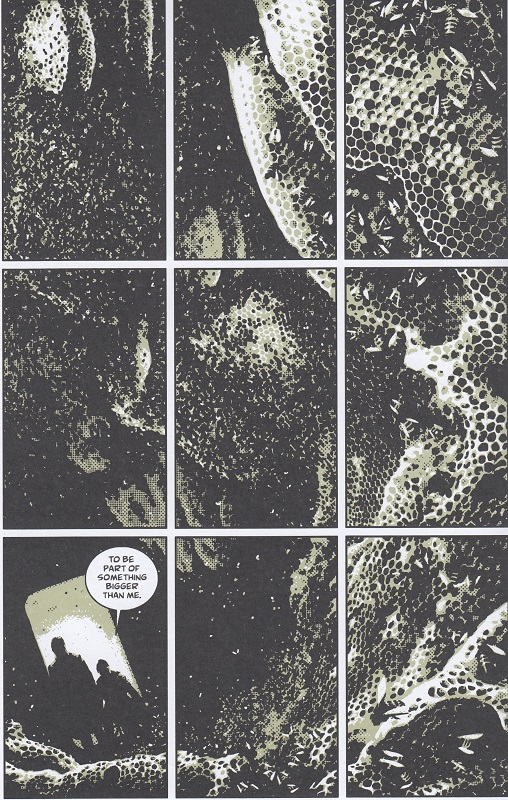
"Busy Bees," in The Seeds, by Ann Nocenti (writer) and David Aja (artist/color artist/letterer)

Originally intended as a 4-issue mini-series to be released under Dark Horse's short-lived Berger Books imprint, The Seeds released 2 issues in 2018, then vanished, only to appear as a complete TPB in 2020. Here's another review of the series I did 4 years ago. 

Earth is dying, or at least that's what everyone seems to think. A billionaire tried shooting himself into space, missed his mark, and crashlanded on Enceladus. The people living inside the walls are dealing with frequent power blackouts and loss of wi-fi or communications networks. The people who moved outside the walls are living in the remains of what's out there, trying to get by without technology. At least, without wireless technology. Phones, Internet, things like that. They still have guns and the wheel and haven't abandoned agriculture. There's a quartet of aliens going around, gathering seeds and biological specimens. They hope the Earth is dying, because otherwise, the stuff they're collecting isn't worth anything.

But I think the point is that life is more resilient than we give it credit for. It's just that our particular notion of "life" isn't going to hold. Throughout the story, technology keeps failing, but life perseveres. There are two people, we only ever see them in hazmat suits. One is convinced their mechanical drone bees will handle pollinization, now that real bees are being killed by insecticides, pesticides mites. Specifically, pollenizing almond trees, because nuts are big money. The other is betting on things like planting wildflowers for the bees, or for fungi to repair ecological damage. At the end, the real bees have turned the drones into building fodder in their hives. The hives they built inside the tech acolyte's power junction boxes, messing them up in the process.

The quartet of aliens are used to dealing with single-celled life. Intelligent alien life (as intelligent as humans get, anyway) is a new thing for them, and it seems to mess with them. Race falls in love, or at least takes an interest in, a girl named Lola. Convinces her to move outside the walls, protects her from her cohorts. Eventually abandons the project. The leader of the quartet loses it, starts watching TV and shooting the sets with rifles. When a reporter named Astra publishes a photo of him and he becomes a star, he goes inside the walls the meet the people who find him interesting. By the end, none of the aliens seem to be making any plans to leave.

If they're actually aliens. There's a panel on the second-to-last page that suggests they may be lab-created by a biotech company, one that flew by earlier (flying over the no-tech zone) and sprayed stuff that killed the bees. The seeds aren't worth anything if the planet's still alive.

Aja draws a lot of nine-panel grids. Sometimes they're each showing individual things, but other times it's part of a larger picture, just broken up into smaller bits. There's also a recurring honeycomb motif, and in many cases, it's revealed by zooming in on something. Show a turtle, then zoom in on the design of the plates on its shell. Or zoom in on the wings of a fly, or an image on a phone screen until we're looking at a few pixels. The honeycomb design keeps popping up, suggesting a connection between living things, that we're not each just individual organisms, and technology is just humanity's best attempt at replicating life.

Friday, June 27, 2025

What I Bought 6/20/2025 - Part 2

I was looking ahead to July, and at the moment, it looks like 2 books out that I'd want every week of the month. Assuming I want to keep buying today's selection, that is.

Resurrection Man: Quantum Karma #3, by Ram V (writer), Anand RK and Jackson Guice (artists), Mike Spicer (colorist), Aditya Bidikar (letterer) - That cover feels like the collage project I tried to do for art in 10th grade.

So, in this story, Mitch and the guy who would become Vandal Savage were a couple of cavemen who found a weird meteor that changed them. Savage killed Mitch, which obviously didn't take, but Mitch, despite making a spear from the meteor, opted not to respond in kind. Even given the chance to go back and do it differently, Mitch doesn't. And then Savage shows up to challenge Mitch while he's protecting Rhea, the scientist lady in Ivy Town.

Mitch wins the fight, still sticking around, right up until Rhea finishes her project (which looks like a Cosmic Cube.) And Mitch takes the cube with him, because his future/alternate self says it'll be useful. Though he Mitch feels bad about hurting her, of course. In the meantime, Vandal Savage comes across the Japanese general, still looking like a skinned corpse. And when he hears how this game came to be like this, Savage lops off his hand and lets the guy eat it.

I guess Mitch can only see his own timeline and the changes he's wrought. Otherwise, he ought to know what his betrayal did to Rhea, the crap Savage is pulling, and so on. I don't know if he'd change what he did - maybe he'd just not get close to Rhea, lurk in the shadows and wait - but it doesn't seem like this attempt to avert disaster is going great.


Maybe that's not really what Other Mitch is after. I don't know why he needs the cosmic cube for this big plan to save things. I'm not sure he is actually a Mitch Shelly. I'm probably not supposed to doubt that, but Anand mostly keeps his face shadowed by his cloak. There were a couple of panels in issue 2 that you could see more of his face, but other than startlingly blue eyes the same shade as Mitch, the faces are such vaguely defined shapes I wouldn't really say they're identical. I'm probably not meant to be doubting that, but I'm suspicious of cloaked figures speaking in vague portents.

Thursday, June 26, 2025

A Skeleton in the Family - Leigh Perry

Georgia's stuck in the vagabond life of an adjunct professor. No tenure, fewer benefits, lousy pay. She gets a job at her old university, and moves herself and her teenage daughter into her parents' house while they're away on sabbatical.

But the house isn't entirely empty, because there's Sid. Sid is a human skeleton that talks and walks and all that. He saved 6-year-old Georgia from a creep at the carnival where someone had set up him as a feature in the haunted house, and ultimately followed her family home. Georgia's daughter, Madison, is not aware of the existence of Sid, at Sid's (unexplained) insistence. The circumstances of Sid's existence are unknown, but he convinces Georgia to sneak him along to an anime convention Madison wants to attend, and sees someone he recognizes. Which sets he and Georgia to trying to figure out why, and ultimately how Sid came to be a skeleton in the first place.

The cover of the paperback says this is the first in a new series, and you can see Perry trying to set things up for future stories. Where Sid lives in the house and other accommodations the family made (such as an armoire in the living room he can lock from the inside.) The range of Sid's abilities, like being able to separate his bones but still control them. The friendship he and Georgia have, with their little quirks and rituals. Georgia's constant background anxiety about the nomadic lifestyle she's lived and subjected Madison to, as well as the thin financial margins of life as an adjunct. The parents will be back eventually, which is, bare minimum, a way to introduce new perspectives and personalities into the mix, but also could displace Georgia and Madison.

Georgia has an older sister, Deb, with a successful security company. This offers someone to give opinions about how Georgia should be living her life (find a man, publish more research so someone will give you tenure), as well as someone who knows how to pick locks. They get a dog, so Sid can have anxiety about it seeing him as the mother of all chew toys.

There's a fling with a fellow adjunct who is also a reporter, though that doesn't last past the end of the book. There's another adjunct, a friend of Georgia's, who dresses nicely but turns out to be living in the office of any professor away on sabbatical. This feels like something that could come to a head down the line, or possibly that he'll find a permanent home with Georgia and Madison (and Sid.)

Perry doesn't stay fixed on the mystery constantly, having Georgia's life - professional, parental, romantic - frequently intercede. Which is fine; it gives a sense of the life she's living, how many plates she's trying to spin. Perry also uses it as time for Sid to get up to his own investigating on the computer, so the case can advance or hit dead ends while our attention is focused elsewhere.

I am curious how many mysteries you could solve with this set-up, but if Perry has Georgia continue her adjunct life of moving from college to college (though that would probably eliminate the sister and the parents as supporting characters), I guess there could always be something new in the new location. Make it a Scooby-Doo thing, only the fright mask character is part of the crime-solving crew. 

'Mom and Phil had spent quite a lot of time theorizing about his origins, deciding he was either a ghost haunting his own skeleton, a vegetarian zombie, a government project gone very wrong, or the most amazing shared delusion ever. None of the explanations stood up to scrutiny, of course, but I hadn't really cared where Sid came from, and Sid didn't seemed to, either. Sid was just. . .Sid. As I told my parents, I could always count on him, even if I couldn't account for him.'

Wednesday, June 25, 2025

It's Hot Out Now, and Fall's a Dud

Diamond's selection of September solicits was pretty thin, but I also went through Lunar Publishing's stuff, plus finding the larger companies' - DC, Marvel, Image, IDW, Dark Horse, Boom - offerings scattered around your various comic news sites.

Not looking great! DC has entirely too many books written by Tom King, and most of Marvel's still about fighting Godzilla, when it's not hyping a new Marvel Zombies, now under their "Red Band" imprint. Now they can be extra graphic with the depictions of eating human flesh (because they'd been so restrained, previously.)

Deadpool/Batman is $7, so I won't be buying that unless I can find a beat up used copy somewhere. Also, Marvel must have decided those comics spinning off from the '90s X-Men cartoon were gold, because they're doing one for the '90s Spider-Man cartoon. And it looks, judging by the cover, like they're going to introduce Morlun. Siiiiiiiiiiiiiiiiiiiiiiiiiiiiiiiiiiiiigh.

What's new I'm buying? Probably nothing. Zethia Space Witch by Anton William Blake, through Cosmic Lion Productions, sounded like it might be interesting. That's as close as anything got, and I had to go back through a second time looking for anything that even remotely jumped out at me to find that.

What's ending? The Thing. For some reason, I thought it was a 6-issue mini-series, but I was wrong. I guess if he fights Juggernaut in issue 4, there's not much room left for escalation. Resurrection Man: Quantum Karma wraps up, although I'm increasingly unsure I'll stick with that.

And the rest: Image's website says Dust to Dust 6 comes out in August, then issue 7 comes out in September. So the mini-series will probably end sometime this fall. Maybe!

Moon Knight's maybe doing a favor for the Wrecker. Which makes sense, as the Wrecker was instrumental to freeing Khonshu so he could resurrect Marc Spector during that Blood Hunt event. The Fantastic Four are doing something in issue 3 to try and stop Doom, the Runaways mini-series is up to issue 4, and Black Cat is on issue 2. Batgirl is getting confronted by the same cult that killed Shiva's parents, so we'll see what happens with that, I guess.

Tuesday, June 24, 2025

The Scarlet and the Black (1983)

Gregory Peck plays Monsignor O'Flaherty, part of the Vatican during the Nazi occupation of Rome during World War 2. While the Catholic Church is taking a "sit and watch" approach, O'Flaherty is working covertly to help downed Allied airmen, escaped POWs, and Jewish residents evade the Nazis and get to safety. The new SS officer put in charge of Rome, Colonel Herbert Kappler (Christopher Plummer), suspects O'Flaherty, but has to tread lightly with Vatican City being considered neutral.

This is apparently based on a true story. O'Flaherty was a real Monsignor in Vatican City, and he did work to help people stay clear of the Nazis. I don't know how accurate this portrayal is, but the movie turns it into a cat-and-mouse game (with life or death stakes, to be clear) between the two of them. There's a big white line that encircles the Vatican, which the Nazis can't cross if they're going to continue to give the appearance of respecting the Vatican's neutrality. Within that, O'Flaherty is safe, but once Kappler's had enough, it becomes almost a prison.

O'Flaherty goes to visit an ambassador, and has to narrowly escape capture when the SS shows up and starts searching the building for him. Kappler eventually stations snipers in windows all around that white line, just waiting for O'Flaherty to cross it. There's a lengthy scene where O'Flaherty walks right up to the line, then paces back and forth, watching Kappler (who grabs one of the rifles and watches O'Flaherty through the scope.) O'Flaherty gets one of the nuns to bring him a variety of outfits, and he starts sneaking out in disguise.

It seems dodgy to expect Kappler to respect that white line, given how often the movie shows his tendency to change the rules whenever he chooses. Disregard embassies, demand the Jewish neighborhoods produce 100 pounds of gold, or else. They meet the demand (with a hand from O'Flaherty), and then the Nazis toss the neighborhood anyway, dragging men off for forced labor, clubbing the protesting wives and mothers with rifle butts. The SS catch one of the priests that works with O'Flaherty, and when he won't talk under torture, has him sent to an Italian prison, to force Italian soldiers to execute him. When they all miss, and their commanding officer can't bring himself to do it, Kappler does it himself.

The movie also frequently cuts to brief glimpses to Kappler's life at home with his wife and children. The contrast between them having a happy Christmas in an opulently decorated home, while O'Flaherty's sneaking through alleys at night to dodge patrols, or escaped Allied soldiers are being hauled off at checkpoints, or trying to climb out the window before SS goons kick the door in. That's all to set up a big moment at the very end, where we see how steadfast O'Flaherty is in his beliefs.

Peck has the air of gravity the role seems to require, steadfast in his belief that he has to do these things, even at the risk of his own life. And he lets just enough anger show through at times to keep O'Flaherty from being entirely sainted. Plummer plays Kappler, I don't know. Sometimes he seems like this is just a job. Like he doesn't really care one way or another, and would just as soon let O'Flaherty do whatever he wanted, except his orders say otherwise. Then sometimes he seems like he believes in the Reich, that it's going to be different than the Roman Empire that is nothing more than relics and statues now, and last a thousand years. (Although, even if the Roman Empire lasted 1000 years, it would still be gone by 1944.) Maybe that's just when he's trying to intimidate people, make them feel it's hopeless to resist.

Monday, June 23, 2025

What I Bought 6/20/2025 - Part 1

I had to make a run out of town Friday, which I turned into a chance to check out some comic stores I'd never visited before. Didn't do great as far as back issues, but I did find 3 of the 6 comics from this month I wanted. 50% isn't so bad.

Moon Knight: Fist of Khonshu #9, by Jed MacKay (writer), Devmalya Pramanik (artist), Rachelle Rosenberg (color artist), Cory Petit (letterer) - Lot of covers of Moon Knight writhing on the ground lately.

Pym whips up a cure for addiction to the magic drug, but it's got to be tested. On someone other than the bent cop they're keeping prisoner, because if she dies, that's bad. If you say so. So Marc acts as guinea pig, meaning he has to get addicted first.

Most of the issue is Marc, either locked in a big steel chamber, or hallucinating he is, freaking out and punching at shadows of his various enemies over MacKay's stint as writer. Each of them tell Marc the same thing: He likes being hurt, so he gathers friends to him to give him someone to drive away when he needs to be hurt. Which is what Deadpool does, though with him, I think it's less about wanting to be hurt, and more about believing, on some level, he doesn't deserve to have friends. So he self-sabotages.

Pramanik and Rosenberg really go to town on this sequence. The images swirling and dissipating around Marc's fists as he tries to shut them up. In one panel, blood sprays off his knuckles because, as we see in the next panel, he actually punched the wall. Zodiac pops up, wearing a padlock on a chain around his neck, and Pramanik uses that for panel borders. There's a bit where, as Marc seizes, we get an extreme close-up of his eye rolling back on the left side of the page, as panels of him collapsing and staring up at all the hallucinations roll down the other side.

Anyway, the really nice twist of the knife MacKay adds in comes after Moon Knight's ridden out the cure and woken up. Hunter's Moon is there, and won't let Marc tell him what he saw in his "visions." When Marc mentions that maybe he didn't like what he saw, Badr almost laughs and asks why he thought he would? Fists of Khonshu are meant to suffer, and to make others suffer. It's a reaffirmation of his fears in just about the worst way. Most "fists" don't have anyone they care about to hurt - as far as we know, Badr didn't have anyone alive he cared about besides Khonshu before meeting Moon Knight's little band -  but Marc's different, and it makes everything worse for him. 

Runaways #1, by Rainbow Rowell (writer), Elena Casagrande (artist), Dee Cunniffe (color artist), Travis Lanham (letterer) - I thought Doombot would never stoop to public transportation. Are they the Loiterers now?

Doom is sending out Doombots to collect all his other Doombots. Which eventually brings Doombots to the Runaways' doorstep - Doombots - at a time - Doombots - when they're less equipped to handle that kind of problem than normal. Doombots! Karolina's still in space with Nico's staff, Chase is still (allegedly) in the future with Future Gert. Gib (the elder god that got left behind) is there, but he doesn't really recognize the difference between the metal men. Which leaves Molly, Victor and Old Lace, essentially, to fight off the Doombots. But then Chase pops up again in a burst of static, so that's, theoretically useful?

I think Rowell's going to have Nico explore some other way to access magic besides the Staff of One. Whether that does anything for Nico's sense that she can't handle all this responsibility is another matter, but if that's really Chase, and he's really back, then maybe she's no longer the sole legal adult in the group. Victor seems insistent on getting Doombot to take a different name. I guess because he feels it'll make Doombot more of its own individual, separate from its programming. Which is significant to Victor, since he wants to think his programming isn't going to make him kill superheroes for Ultron. Doombot doesn't much seem to care. I'm not sure how he reconciles the duality of knowing he's not Doom, but still thinking of himself as Doom, but he seems to make it work. 

Molly seems really concerned with things not changing. Probably because at this point, change means people leave, and she doesn't like that. Instead of one of her usual hates with the perky cat ears or whatever, Casagrande gives Molly a hat with droopy ears, plus the brim is slanted down. It doesn't really shadow her face - Casagrande's not going that dramatic - but it does add to Molly's depressed air.(Karolina probably should have figured out some way to keep in touch.)

And with Gib just sitting around most of the time, leaves Gert as the level-headed one trying to navigate through all this. Which is not really new, but Gert's extremely cynical brand of realism - like my own - is not best suited for herding this particular group of cats. 

Sunday, June 22, 2025

Sunday Splash Page #380

"Dossier", in New America #1, by John Ostrander and Kim Yale (writers), Gary Kwapisz (penciler), Aubrey Bradford (inker), Sam Parsons (colorist), Tim Harkins (letterer)

One of these days, Saturday Splash Page will actually get to Tim Truman's Scout - some day, maybe - but for today, the other of the 2 mini-series set in the gap between Scout and Scout: War Shaman (the first being Swords of Texas.)

New America follows the rise of Scout's old acquaintance Rosa Winters from soldier, to general, to, at the very end, President of the new United States of America. Each issue centers around a single operation. Most of them are collaborations between the coalition government Rosa's working for and Israel, and serve as sort of window into the state of the world in this timeline. In issue 1, Rosa convinces the priest brother of a dead revolutionary to take up the cause and spur the people of Baja into revolt after the Communist Mexican government agrees to sell the province to Japan in exchange for munitions factories.

In the second issue, Rosa and the Mossad squad wipe out the royal family of the Kingdom of Alaska in such a way that both Russia and Canada (the two larger powers that flank the kingdom and which it uneasily plays) think the other is responsible. The third issue is a rescue mission of the Pope, held captive in Colombia by a drug lord that runs the country.

The course of the story is that Rosa grows hardened against loss or betrayal. Father Galvez is assassinated during a speech in issue 1, but Rosa catches a glimpse of one of the Mossad agents slipping away with a sniper rifle in the chaos. Dead martyrs are easier to control than live ideologues. Rosa has no qualms killing the sniper when the opportunity presents itself during the liquidation of the Alaskan royal family in the second issue, or at killing the rest of the squad at the end of issue 3 to ensure the Pope stays in America's hands rather than Israel's. Earlier in that issue, one of the Israelis had mentioned that Rosa was their friend, but the other squadmembers are their family, as is their country. And so, when she kills them, Rosa explains that her country is her family, and friends come second to that.

Politics may make strange bedfellows, but never one you sleep with your back to, apparently.

This hardening of the soul, the shearing away of compassion or mercy, is mirrored in her external appearance. She loses a hand in the first issue, replaced by a cybernetic one with guns built in. It's those she uses to kill her former friends and allies, the guns responding to her thoughts, something she explained required a lot of practice and control to use properly. Which is true; she doesn't take the hand off while she sleeps, so imagine the potential risk if your head rested on your hand and you had the wrong stray thought?

The final issue begins with her appearing to die, shot down in an ambush brought on by Israel selling her out to President Bill Loper. Because Israel gets the Pope back in exchange, though neither side has any illusions about this being some long-term partnership. Just as Mexico and Japan each thought their arrangement was the key to the eventual conquest of the other. The end result is, Rosa becomes leader of what's left of the opposition, but now both hands are cybernetic, along with one eye and ear.She keeps her face hidden now, behind sunglasses and a bandanna, beret pulled low.

She hires the gun-runners from Swords of Texas to act as a lure for Loper's tank forces, so she can ambush them with what's left of her army. There's no qualms about letting Banner's people sweat for a bit while surrounded by enemy tanks, because it's the best way to make sure the ambush works. And for that battle, Rosa's pilots a specially-modified tank that she can plug her hands into and control with her mind. (The way Kwapisz draws it, she reminds me a little of that member of the X-Men foes the Reavers that has a tank for a lower body.) Loper flees, and Rosa pursues him all the way to his broadcast station, where she murders him in the middle of a televised plea to the nation.

Appeals to the populace are a big part of this mini-series. Galvez is killed during a speech encouraging the workers of Baja to unionize and resist both the Mexican and Japanese governments. The pope brings about his own rescue with a public address, which Mossad makes sure isn't interrupted, that announces he's held prisoner by the drug lord and probably going to be killed. Loper goes for a similar approach, though it feels more like a man on his deathbed, pleading with his Maker. But the Pope and Galvez were true believers in their causes. Loper might be religious, though it feels like the bullshit, mega-church televangelist type, but he just wants to save his own neck.

Issue 2 lacks that angle, but it's also the issue where Rosa spares the youngest daughter of the Alaskan royal family, ultimately adopting and renaming her after the President Rosa served before Loper had her killed. It's the little bit of mercy and kindness she's demonstrates, her one action in the mini-series that isn't motivated by political maneuvering or revenge.

Saturday, June 21, 2025

Saturday Splash Page #182

"Thinking Inside the Box," in Sensational She-Hulk (vol. 1) #14, by Steve Gerber (writer), Bryan Hitch (penciler), Jim Sanders III (inker), Glynis Oliver (colorist), Jim Novak (letterer)

John Byrne was writer/artist for 27 issues of Sensational She-Hulk, but what about the other 33? The answer is, it's a real mess. The book had 10 different writer (or writer teams) over those issues, and 10 different pencilers. I don't know if nobody particularly wanted the job, Marvel couldn't find someone they liked or what. There's a lot of one-offs, although the writers seem to pay attention to what each other were doing. Scott Benson does a fill-in for #51, where She-Hulk is desperate for a story for the issue, and jumps into an inventory issue from her Savage She-Hulk days, and only makes it through with some help from Tommy, the lone Marvel intern at the office. Sholly Fisch brings back Tommy in issue 58, now trying to be Jen's costumed sidekick as she fights an Electro so drunk on power he thinks he's an "electrical elemental." 

Most attempts at stability didn't last. After Byrne left the book the second time, Marvel went with Michael Eury and Zach Britton as writer/artist team. Eury wrote a 6-issue story about an enemy trying to drain the gamma radiation from Jennifer's blood and nearly getting her killed, but Britton only drew the first issue (where she fights Titania in a lingerie store), then vanished, with most of the remaining issues being drawn by Pat Olliffe.

The only two who stick around for any length of time are Steve Gerber, who wrote a total of 16 issues (3 of those with Bruce Dixon), and Bryan Hitch, who drew 13 issues. The two mostly overlap, which is nice. Gerber maintains some of Byrne's status quo, Weezie Mason and the flying car Jennifer got after a trip to outer space. (Also the bit about Jen having sexy dreams about Hercules, though it's Simon Furman who writes an issue where Herc finally shows up.)

However, Gerber kicks her out of the District Attorney's office (though she's back at that job in the last few issues of the book) after a defendant argues her actions saving people from a falling communications tower unfairly prejudiced the jury. Dan Slott would also use this in She-Hulk volume 1, and Mark Waid did something similar in Daredevil. Gerber focuses more on his typical social commentary/satire stuff. His first arc involves Jennifer being enlisted by a shadowy figure Byrne hadn't fleshed out, who turns out to be "Lexington Looper." Lex is in danger from a former employee who stole a device that can project whatever images you wish to a person or persons and make them feel or believe whatever you want. Perception as reality, facts are irrelevant. So "Pseudoman" projects the image of a train bearing down, and Jennifer is terrified. Jennifer tries a flying tackle, but he projects himself as powerful and immovable, and she gets tossed blocks away.

After that, Dr. Angst (see Sunday Splash Page #343) reverses a black hole via giant, magical plunger, so that it starts spewing matter into the universe, essentially filling it with other universes until only the most dull, mundane places are left for he and his old associates to rule, everything else smushed together and out of existence. The only one aware of it is an offshoot of the Watchers, called the Critics. He ropes Howard the Duck in, because he can't get too involved and Howard's got experience with this sort of crap, then sits back and critiques how things are going.

With that approach, it's no wonder Gerber declines to have She-Hulk break the 4th wall. Any more broken walls, the entire book would collapse like an imploded sports arena.

Hitch is still in his Alan Davis-lite era, which, to be clear, I prefer to his style from Ultimates to the present. And it better suits stories like these, with their absurd or comic tones. He's got to draw a talking duck in a universe of nothing but cold cuts and tomatoes, that does not call for a photorealistic look.

I wouldn't say the non-Byrne creative teams do away with the fan service. Like I said, the lone Eury/Britton issue involves a fight in a lingerie store (complete with the Thing helping out while being embarrassed about being there and wondering how women fight in so little, which ignores that he fights in his underwear.)But they aren't devoting pages specifically to She-Hulk doing sexy poses or jumping rope, I guess.

Both Gerber and Eury do stories where she switches between different looks. Big and grey and monosyllabic, ala early Hulk, or her Savage persona, or back to mousy Jennifer Walters. I don't know what either writer was trying to say with that. Maybe they just wanted to shake things up. Byrne basically left her as is, minus the Christmas issue where she briefly transforms back into Jennifer as a gift to her dad (courtesy of her team-up with a lecherous Santa Claus in issue 8.) Man knew what he wanted to draw.

Friday, June 20, 2025

Random Back Issues #154 - Our Fighting Forces #132

Who knew a dog could do the "slow bad-ass walk away from an explosion" bit? 

Of the 3 stories in this issue, we start with Robert Kanigher & John Severin's, "Pooch: The Winner", less a Losers story and more a flashback to happier times. On their way to a mission briefing, Gunner and Sarge spot someone entering Buckingham Palace. It's Pooch, an all-white dog that served with them in the Pacific Theater.

Pooch remembers them, too, and thus begins the flashback, where we see Gunner and Sarge weren't excited initially about their new partner, but Pooch immediately warns of a Zero diving silently out of the sun, and that's convincing enough. He later saves a whole group of Marines from being killed by a 'banzai charge', Japanese infantry planning to hold onto their grenades until they're on top of the Marines' ammo dump. Which raises the question, why did the barber set up next to the ammo dump? There must have been other boxes to use for chairs somewhere.

Pooch falls ill, and minus his senses, Gunner and Sarge are captured on their next patrol - clearly having gotten lazy, trusting the dog to do all the work - with the idea they'll be bait to lure the other Marines into a trap. Pooch leads the way, catching a bullet in the process (though he stays upright long enough to chew through the ropes holding Gunner and Sarge.) While he recovers, Gunner and Sarge are redeployed to Europe, where their entire squad is wiped out in the first battle. They meet Captains Cloud and Storm not long after, and we return to the present. Pooch seems eager for a team-up - likely more fun than whatever function he's attending at the Palace - but Gunner and Sarge figure their "loser" stink would finish Pooch off for sure this time. Or maybe having your super-awesome dog pal back would turn things around?

"The Invincible Armada", by Kanigher and Ric Estrada, is a "history repeats itself" story, as we open on Don Julio Francisco Alverez y Diego promising to bring his son the head of Sir Francis Drake as a present (as seen in Sunday Splash Page #193.) Yes, it's time for the Spanish Armada to invade England! There's no way fighting a naval battle against the British can go badly! Don Julio's pretty cocky, but Drake's smaller ships are too nimble to hit. As he falls beneath the waves, Don Julio vows the Armada will return.

The only returning his widow does is to Prussia, but 350 years later, his descendant, a Luftwaffe bomber pilot, prepares to "avenge" the defeat. But the Nazis are apparently still operating under the delusion the "bomber will always get through", so there's no fighter support, and Spitfires send Don Julio the Sequel to a watery grave of his own, his plane coming to rest beside a Spanish galleon (remarkably well-preserved after 350 years.)

"Cabbages and Kings" is one of Sam Glanzman's U.S.S. Stevens' tales, this time focused on a Bo'sn Egloff, who ventures on deck during a typhoon to make sure everything is secured. While he gets the guns taken care of, some of their food was stored topside for lack of room below, and the crates burst, flinging cabbages everywhere. While Egloff ties down the remaining food, he notices an ensign being swept away. Egloff saves him by chucking a "monkey's fist", a lead weight on the end of a heaving line, then towing him back aboard. The ensign (who looks years away from being able to grow facial hair) was trying to help Egloff, but just ended up creating more work for the man. That's why I don't do group projects. 

{4th longbox, 161st comic. Our Fighting Forces #132, by Robert Kanigher (writer), John Severin and Ric Estrada (artists), Sam Glanzman (writer/artist), colorists and letterers unknown}

Thursday, June 19, 2025

"Descent Into Madness" is Literal

Charles Reed's a private investigator out of Boston, who has traveled to the town of Oakmont to seek the answer behind the hallucinations he's been having. The Sinking City is about his investigations into that, as well as all sorts of other things happening in the city, and below it.

Most of The Sinking City revolves around solving mysteries. This takes a number of forms. Asking questions of witnesses or acquaintances, but sometimes checking various archives. The library, the police station, the hospital, the newspaper. The trick is figuring out which archive you need. Is information about a current prominent church in the newspaper or the library? For a person's death, do I check with the cops or the paper, or maybe the hospital?

I don't want to give the impression it's actively dangerous to have to travel from one to another. As long as you don't try to short-cut through the "infected" zones - clearly-marked areas where the various smaller Lovecraftian horrors have taken over - you aren't going to encounter any hazards. It's just time consuming, and I wasn't always sure if I wasn't finding anything because I was looking in the wrong archives, or because I hadn't found enough evidence for the game to decide Charles could make the deductive leap to what he needed to search for.

Because the other type of investigating involves nosing around the scene of the crime. A symbol will pop up on something you can interact with, or at least observe. Sometimes you can pick the object up, sometimes not. Charles also has a sort of second sight. Sometimes the screen will get these pulsating lines and you hit "X" and it reveals something that happened. I assume via psychic residue imprinted on the object, I think that's called psychometry, Longshot's other power besides the luck and hollow bones.

At a certain point after you gather enough evidence, a void will appear in the place, and if you walk Charles through it, he can pass through these floating clouds which show a recreation of part of what happened. Once you walk him through all of them, it's up to you to figure out the order things occurred in. If you get it right, the screen flashes green and Charles recaps. If you get it wrong, the screen flashes red and you try again.

You don't want to take too long, because that sort of thing drains your sanity meter. The effect of that is mostly that Charles hallucinates. Stuff like slugs with sharp mandibles, or himself hanging from a noose, or a creepy doctor advancing on him with a gun. First time I saw that last one, I snapped off a shot at it on reflex. After a while, that stuff was pretty easy to ignore, it was the way the screen would wobble and warp that gave me headaches. There are drugs Charles can take to get his sanity back faster - really wonder what 1920s medicine was prescribed for that - and they aren't to difficult to craft more of, so I'd recommend using them to spare yourself the headaches.

The thing is, sometimes you can get to that point without gathering all the available evidence (the game will tell you when you've collected all evidence in a place.) And if you haven't, and go to the archives, even though you know exactly what you're looking for, Charles apparently doesn't. So you have to go back and keep nosing around until you find what you missed or you can't progress.

There are a lot of mysteries or cases, some vital to the story, others just sidequests. Although some of the vital stories feel like sidequests. One guy won't tell you what he saw unless you get him passage out of town. The only guy who can arrange that is a crook, and he wants something, and so on. A couple of times, I forgot what I was investigating originally. The main cases usually give you an option on how to proceed, once you put together enough of the clues in your "mind palace" to come to multiple conclusions. Each option is phrased in the way Charles would mentally justify it, but the game lets you pick whichever you prefer.

Example: You have been framed for murder. The danger of being an outsider in an insular, weird town. The key witness is running for mayor, but needs money, and might just be inclined to change his statement, if you poison his mother so he can get his inheritance. Or you could bring in the actual killer yourself, maybe even convince him to turn himself in. Or you can pin the murder on the aspiring politico, which is what I did. Hey, I found a map on a wall suggesting he was tied up in something big with a lot of other people I was pretty sure were involved in dragging me here. I don't think Charles ever made that connection - didn't say anything aloud if he did -  but I guess he's just not as good a detective as me. Which leads me to wonder how he hasn't starved to death if this is how he makes his living.

Most of the sidequests are more simple fetch-its. The guy with the room next to yours in the boarding house disappeared, but left a list of places he thinks the "damn Innsmouthers" were hiding treasures. The treasures aren't actually things you can sell - there's not really any buying or selling in this game, just scrounging for supplies, or being paid in bullets and alcohol and whatnot - so it seems like the main reward is whatever you scrounge while searching. Is that worth it? I don't know. Sometimes felt like I was using more bullets than I was getting back, but at other times, I definitely was coming out ahead.

Which is nice, because there's a fair amount of combat on land, and bullets and firebombs will kill the creatures you run into. (You've also got a shovel, but I don't recommend using that for anything except the knee-high spider things you encounter.) My fights were usually a frantic affair of me firing while backing up or trying to run in circles to keep them at bay. If you flee the building you can eventually get far enough away they'll sink into the ground, which might give you time to boost your health (or mental health) back up if they're getting low. If you try that within the building, they're liable to simply appear on whatever floor you ran to and resume pursuit, which was an unpleasant surprise the first time it happened.

But at least you can fight them. Periodically, the game sends Charles underwater. He was in the Navy in WWI and has experience with diving suits. Handy! Also experience with seeing things underwater that drove him mad. Less encouraging! Though the game gives you a speargun and some flares whenever you descend, I found those pretty useless. The speargun might temporarily slow the crocodile-jawed squid-things that come after you, but they don't kill them. And while you can repair your suit when it gets damaged, you have to stand still and repeatedly tap a button for that. Which you can't do if the aforementioned crocodile-jawed squid thing is attacking you.

I really hated the underwater parts, precisely because it felt like Charles surviving until I got him where he was going was down to luck. I gather that in Lovecraft stories the protagonist is often confronted with something they can barely comprehend, and which is far beyond their ability to harm, but this didn't feel like that. It wasn't that Charles kept having to walk past immense, many-tentacled horrors whose mere presence shredded his sanity like a napkin at the claws of a cat (though those things are out there.) It was just a sort of standard monster thing, but the tools the game provided were insufficient. Like I'd been meant to upgrade the speargun, but missed the cue.

Back to the surface. Oakmont's become largely cut off from the world. Large portions of the city are flooded, so getting from Point A to Point B involves switching between running, and driving little boats with outboard motors down what used to be streets. Again, the game allows you to move around unhindered. There are a few stock character models - weirdo religious cultists, guys trying to sell newspapers, homeless men fighting over stuff, cops - that repeat over and over, but you can walk past them with no trouble.

The city, even beyond the rising waters, is slowly being overcome. Walls are rotted and collapsed, or covered with what looks like reefs or giant barnacles. Dead sea life washes ashore alongside the rusted hulks of ships. Everything has this sheen that makes it look slimy or unhealthy. I didn't want to let Charles touch any of it, feeling like something would immediately start growing over him.

Charles himself spends the entire game with 5 o'clock shadow and deep bags under his eyes. I'm guessing he hadn't gotten a good night's sleep in months, and doesn't get one for the duration of his time in Oakmont. I think I played him like that for the most part. I'd go along with whatever grandiose notions or assorted nonsense a character might spew until getting the information I needed. Then I was usually done with that and would tell them what I thought of them before we started shooting it out. Man's tired, he can't be expected to keep listening to bullshit forever.

And there's a lot of bullshit, or perhaps mania, in Oakmont. Even the characters that don't strongly resemble fishmen (the Innsmouthers, targets of much racial prejudice) or apes (the Throgmortons, because the deceased Papa Throgmorton apparently divorced his wife and fucked a gorilla at some point during a trip to Africa) fall into the uncanny valley. A lot of them sport weird grins, with eyes too large and bulging. Even the ones that are dealing straight with Charles, I hesitated to trust because their design screamed, "Something's wrong inside this guy."

There's a lot of backstory about churches and great families and founders but, since I was going three weeks sometimes between playing, I forgot most of it. It's not essential to the gameplay except to the extent it helps you figure out a given case. Once that's done, feel free to forget. If it's a critical point - say, about the Seed or the Dreamer, which heavily relate to Charles himself - the game will remind you later.

I don't love the sanity meter, and I definitely don't love the visual distortion effect when the meter's changing, but I enjoyed the game. It took a while for me to get into it, find the groove of collecting evidence and putting things together, but once I did, it really took off. The combat wasn't anything special, but it's challenging enough to keep me on my toes, and Charles looking over his shoulder.

Wednesday, June 18, 2025

An Unkillable Exemplar of Batman's False Hope

Marvel and DC are going to do another crossover this fall. Or two, maybe. Both Batman & Deadpool (Batman vs. Deadpool?), but one published by Marvel (in September, by Zeb Wells and Greg Capullo), and one by DC (in November, by Grant Morrison and Dan Mora.)

My initial reaction was to groan. I fully expect Wells to go a humor route, with lots of Deadpool making dumb jokes or comments - odds on a Batman v. Superman "Martha? Why did you say that name?" reference? 1:1? - and Batman being irritated by his inability to either get away from Deadpool or shut him up. Or an opportunity for Batman to fight somebody that can take everything he can dish out and keep coming. Could get old very quickly either way.

But Deadpool is, in some ways, a perfect Batman antagonist. Wade Wilson suffers from mental illness. A highly variable and extremely comic book-y type of mental illness, but mental illness all the same. He has done horrible things, hurt and killed people, in some cases without remorse. Maybe because they threatened people he cared about, but sometimes simply because he was angry at the way things were going in his life and they were convenient targets.

And yet. . .sometimes he does the right thing. He helps people who have been hurt or exploited. He saves the world. Sometimes he still doesn't do the right thing, but not for lack of trying. He really tried to be a good Avenger, really tried to live up to Captain America's belief in him. But he was too willing to trust someone else's judgment if they gave him praise, which is how he ends up following Stevil Rogers' orders during Secret Empire.

Most of Batman's arch-enemies are people with mental illnesses. That's why they go to Arkham, an admittedly shitty asylum, but pretty much all Gotham has if you want to treat them so they can re-enter society without being dangers to themselves or others.

Some times it even works! Harvey Dent gets better. The Ventriloquist gets better. The Riddler at least shifts his impulse to prove his intelligence to solving crimes as a p.i. instead of committing them. Harley Quinn gets better. Poison Ivy, so on. Most of them backslide, sooner or later. An endless cycle of progress, then regression.

Deadpool is almost a perfect example of what Batman's working towards. Without ever getting any real help from a mental health professional (Dr. Bong doesn't count, nor does Cable doing telekinetic brain surgery), Wade Wilson still has periods where he can function. Can have friends, have a home, have a family. Sure, he still frequently beats the crap out of people, but most of them are trying to hurt innocent people. Batman can't exactly throw stones about that.

I don't know if I'll buy either book when they come out, but I can't say for certain that I won't. Which is more than I would have expected at first glance. 

Tuesday, June 17, 2025

Indiana Jones and the Kingdom of the Crystal Skull (2008)

Indiana Jones gets roped into finding a missing colleague and the mother of a smart aleck James Dean wannabe (Shia LaBeouf), while racing against the Soviets to find a long-lost city and the great power within. 

So Spielberg decided to move the timeline forward to the '50s, and with it, shift to a more sci-fi plot, and also shift the antagonists to the Soviets for the Cold War era setting. Although my dad and I agreed Cate Blanchett's weird "doctor of the paranormal" character would have fit as well as a Nazi scientist. Maybe she switched sides.

And really, most of the action would still fit with the pulp aesthetic of the earlier movies. The search through the graveyard for the conquistador's grave, complete with a couple of local weirdos trying to ambush them from the shadows with blowguns. The quicksand, or whatever it was Indy said it was. The ancient temple with traps - why would you set it up to open a path beneath the obelisk, but design the stairs to immediately retract into the walls so people get dumped onto enormous spikes - and gold. The chase sequence with people switching vehicles during the whole thing. And the alien science might as well be magic. Like Indy says, what God looks like depends on what God you worship.

If the movie wanted to do more with the Cold War paranoia, maybe play up the FBI suspecting Indy's loyalties beyond them pressuring the university to kick Indy out. I guess that was "Mac's" (Ray Winstone) role, as the guy Indy thought of as a long-time friend and ally, who turned out to be a backstabbing traitor, then pretended to be acting as a double-agent, but was really just a greedy pig all along.

Blanchett doesn't get a lot to do. As an antagonist, she's at least a little different from Belloq (Raiders) or Donovan (Last Crusade.) At the end of the day, those guys were more like Mac, just interested in themselves. Belloq wants the credit and aggrandizement of finding rare treasures. Donovan thinks to use the Nazis to gain immortality because he's afraid of death. Even Mola Ram was ultimately a phony, trying to hoard power for himself. Dr. Spalko does want knowledge for herself, but I think she's also a true believer in the Soviet ideals.

I'm not sure the movie does enough with that either. Feels like there ought to be a difference between dealing with a ruthless ideologue versus self-interested egotists. But hell, I got to watch her kick the crap out of LaBeouf in a sword fight atop two jeeps. That was fun, better than him swinging through the trees like Greaser Tarzan, but he does alright with the role he's got. Cocky, impulsive, in over his head but game to try nonetheless.

Karen Allan still has an easy banter and chemistry with Harrison Ford, though it comes out more when they're arguing and sniping at each other. It's funny how the rest of the movie seems to just come to a halt, like all the characters decide this is too good to miss, so they just stop to watch.

Monday, June 16, 2025

There's Always Hoops to Jump Through

Florida Man banned from all national parks after sharing methamphetamine with elk.

Robin's admitted she wants to live and keep sailing with the Straw Hats, so One Piece, volume 42, is the Straw Hats crossing the gap to breach the Tower of Law and get her back. Unfortunately, she's wearing seastone cuffs, which neutralize her Devil Fruit and are (somehow) hard as diamonds.

Each CP9 member has a key, so if the Straw Hats want to truly free her, they have to beat all of them to get the right key, and rescue Robin before Spandam (being escorted by Lucci) gets her through the Gates of Justice. As a thief, Nami ought to be able to pick the lock, but this lets Oda split the crew back up and throw them into 1-on-1 battles against CP9. That consumes the remainder of the volume (and the next 2), so how are they doing?

Not great! Nami gets a key away from Kumadori, who speaks in these bold, poetic (and moronic) statements, but he's too strong for her and she can't escape him. Chopper, who intervenes, can't seem to beat him, either, though he does temporarily trap him in the fridge in the Tower of Law's kitchen.

Zoro was holding his own against Kaku, despite Kaku having gained a Devil Fruit that lets him become a giraffe-man since their last encounter. But they end up in the same room as Sniper King (aka Usopp) and a wolf-man agent. In the middle of all that, Usopp manages to cuff himself to Zoro with a different set of seastone cuffs. Neither of their opponents has the key to that pair, so it's a lot of them running away or Zoro trying to wield Usopp like a sword until Chopper can maybe find the right key.

Sanji, meanwhile, runs up against Kalifa, the sole member of CP9 that's a woman. And Sanji, of course, won't hit a woman. So even though he's stronger than her, he's summarily tossed out of her room, reduced to some odd state where he looks like a partially-completed clay sculpture. Nami sees through his claim that he couldn't win, recognizing he didn't really try, and he responds he won't fight a woman, even if it kills him. Not to put too blunt a point on it, but who gives a fuck about his life? After all his big speeches about being the one to rescue his "Robin-chwan," he won't even fight for her.

At any rate, this leaves Nami fighting Kalifa for another key, in the hopes it'll be the one to Zoro and Usopp's cuffs. And while she eventually figures out Kalifa's new Devil Fruit, she's still too slow to actually do anything about it.

The one person having any success is Franky, who manages to defeat Fukorou, though it's a back and forth affair. Franky initially runs out of fuel (cola) and there are a few gags of Chopper throwing him the wrong drink because he's trying to open and shut the fridge door before Kumadori can escape. Once Franky's back to full strength, Fukorou starts relying on his greater speed and agility, plus his ability to "moonwalk", meaning walk on air. Franky, like he did in his fight against Nero on the Sea Train, has to find a way to counter that maneuverability.

Their battle destroys the fridge, freeing Kumadori. Chopper wins out over that dope, but in the process turns himself into a mindless, rampaging monster that can't distinguish friend from foe. So even when things go well, they go poorly. Case in point, Luffy (who was so focused on beating up Rob Lucci the rest of the crew left him to it) catches up to Spandam and Robin. While Luffy tries to get past Lucci, Spandam fucks up and triggers the Buster Call in his attempts to taunt Robin about how worthless she is. Now the Marines are going to level Ennies Lobby and everyone in it. Just as soon as the flotilla gets there, in say, 30 minutes or so.

Nothing like a ticking clock. . . 

Sunday, June 15, 2025

Sunday Splash Page #379

"Silent Flight," in Nausicaa of the Valley of the Wind vol. 1, by Hayao Miyazaki

I bought the first two volumes (out of 7 total) of the manga version of Nausicaa over a decade ago. I would swear I reviewed them briefly at some point, but can't find proof anywhere in my archives. Maybe I just remember asking David Brothers about the book on his tumblr because he'd mentioned reading it, and I was trying to assess my, dissatisfaction? Disappointment?

It's a gorgeous book, no question. Towering forests where the air is laden with fungal spores that are lethal, and giant insects almost as dangerous. Flying vessels that vary from gliders to "gunships" that kind of look like someone added wings to the business end of a rifle to larger transports that resemble WWII bombers. Ruined cities and the remains of ancient war machines. Miyazaki knows when to draw back and show how small a human is amid a dangerous world, and when to focus on how that person reacts or observes that dangerous world. 

Nausicaa, the future chieftain of the Valley of the Wind, often looks at the forest with a mixture of reverence and sorrow. Appreciating the beauty of her surroundings, but aware this is a place where she has to tread lightly and carefully. Asbel, the surviving prince of a neighboring kingdom Nausicaa meets near the end of volume one sees everything in the forests as a threat. They both cover the lower half of their faces with masks for protection, but where Nausicaa's eyes are open and aware, Asbel's are narrowed in anger and hostility. He attacks before anything can attack him, which only puts him in greater danger.

At least in volume 1, the story seems to be that the world is gradually cleansing itself of the damage humanity inflicted through poison and war, via the encroaching "Sea of Corruption." It leaves behind a land free of the toxins, but the land seems to be a sterile sand, so does that leave anything for humanity if they can hang on? Humanity, meanwhile, is on its usual bullshit, with different kingdoms attacking former allies in a bid for control of ancient weapons, and even some scrabbling for control amid the siblings of the royal family of Torumekia.

Miyazaki establishes very early that Nausicaa has some connection to the natural world that most people don't. She can feel the thoughts and anger of the great insects, but can also be overwhelmed by their anger. I think that was where volume 2 lost me (guessing, because I gave it away several years ago.) It seemed as though the subsequent volumes were going to delve further into Nausicaa as this chosen one, and that there were mysterious figures trying to use magic to manipulate her mind and control her. I just remember not being enthused by that, which is why I never got around to buying the other volumes.

Saturday, June 14, 2025

Saturday Splash Page #181

"Out of Bounds," in Sensational She-Hulk (vol. 1) #5, by John Byrne (writer/penciler), Bob Wiacek (inker), Glynis Oliver (colorist), Jim Novak (letterer)

Having never read Savage She-Hulk, Jennifer Walters' first ongoing series, my impression is it was the classic Hulk formula, but Hulk was a girl. She-Hulk wears a ripped-up outfit, talks in simplified sentences, punches monsters, and gets chased by the authorities (in Jen's case, I think it was her dad, who was a sheriff.)

After that ended, she spent some time on the Avengers, then replaced the Thing on the FF post-Secret Wars, the latter when John Byrne was writing and drawing the book. Byrne turned down the savagery, with Jennifer Walters being in control as She-Hulk and generally loving being a big green lady. He also upped the sexy aspect of the character, which continued to an extent once Sensational She-Hulk started up (preceded a graphic novel of the same name.) Byrne gives She-Hulk a lot of different outfits to wear, for work and play and working out and whatever else, and spends more than few pages on her trying out different stuff or commenting on not wanting a good outfit to get wrecked in a fight. She-Hulk being fun-loving, confident clothes horse is probably what's stuck the most consistently in the 30+ years since this series.

The less consistently applied, but arguably more significant, change Byrne makes is Jennifer becomes aware she's in a comic book. She takes advantage of an issue actually starting to cycle through her wardrobe quickly by changing between panels, or yells at Byrne about using the Toad Men for alien invaders, or (in Byrne's second stint on the book), his propensity for having characters try to marry her. Byrne also adds Louise "Weezi" Mason, the Golden Age Blonde Phantom, to the cast. Weezi ends up being meta-aware as well, and admits she finagled Jennifer a job working in the District Attorney's office (Weezi's boss), because even being just a supporting cast member will get her enough page time to slow her aging any further.

Of course, Byrne later has her fall in a vat of stuff the Mole Man's got laying around, and Weezi gets de-aged (and slimmed down) back to her early 40s. Yes, not long after he de-aged Spitfire in the pages of Namor, and yes, Weezi comments on the fact Byrne's getting obsessed with aging and mortality since he hit 40. Then Weezi starts dating Jennifer's dad (no longer trying to arrest She-Hulk, but still not happy his daughter's 6'10" and bright green), gains a little weight, gets angry about how plump Byrne's drawing her, and goes on strike while Jennifer's in the middle of a fight with Xemnu the Titan in an outer space truck stop.

A fight which Byrne initially illustrates as a "fromage" (his word) of Siryn fighting Juggernaut in X-Force #3. I mean, he mimics the postures exactly (She-Hulk standing in for Siryn, Xemnu for Juggy) and shifts his art style to a more Liefeldian look for 4 pages, until his editor Renee Witterstaetter marches into the book (dressed like she stepped out of the night club from the opening scene of Temple of Doom) and tells him to knock it off and start over.

That's the kind of book it is under Byrne. Kind of goofy, full of jokes about issue 3 being the obligatory, sales-boosting Spider-Man guest appearance, or doing a cover referencing the magazine cover of pregnant Demi Moore (She-Hulk holding a beach ball in place of being pregnant.) Byrne was writer/artist for the first 8 issues, left for almost 2 years, then returned on issue 31, with a cover showing She-Hulk and Renee stopping him from renumbering the book back to #9. Even if he's stymied there, Byrne does treat everything in between his runs as a lengthy dream sequence for Jennifer.

Byrne sticks to stories that are 1-3 issues long, fitting with the book's policy of only using "lame" villains. Byrne includes Xemnu and the Headmen in that category, along with Gamecock, Stilt-Man, and Spragg, the Living Hill. I feel like not all those characters deserve being lumped under that umbrella, but so it goes. But all the weak villains and focus on jokes or on drawing She-Hulk in various sexy outfits, means it doesn't feel like Byrne's got an overarching story of theme he's working towards. Maybe "draw a giant sexy green lady" was the overarching theme.

I think Byrne's first 8 issue stretch is stronger, maybe because his second stint feels more gimmick based. The Liefeld homage, the "naked jump rope" bit (which I was afraid ran for the whole issue, but thankfully does not), everybody trying to marry She-Hulk. The artwork's very nice throughout; Byrne at least seems to be having fun drawing She-Hulk fighting goofy villains or spending a few pages letting her fall through a pitch-black tunnel. He's usually being inked by Bob Wiacek, though partway through the second stint She-Hulk gets Byrne to use the duotone paper he'd been using on Namor (until Wiacek starts inking him there) for her book instead. I'm not sure the rougher texture it gives his art works as well here, though Jennifer describes it as feeling like she's wearing corduroy.

Byrne's second run ends at #50, which is mostly an excuse to get other artists - Dave Gibbons, Frank Miller, and Walt Simonson among them - to do 2-page gags about their version of a She-Hulk book. But the book ran for 60 issues total, and Byrne was only responsible for 27 of those, so we'll look at the other half of the series next week.

Friday, June 13, 2025

What I Bought 6/6/2025

Of course, as soon as I mention wanting to review movies I've had for a while, I visit my dad for a weekend and we watch a bunch of new (to me) movies. Maybe I'll start in July. Today, one book from last week.

Batgirl #8, by Tate Brombal (writer), Isaac Goodhart (artist), Mike Spicer (colorist), Tom Napolitano (letterer) - It's like the words came to life, and bled all over the pages.

Continuing with Shiva's backstory, she and her sister (now going by Sandra and Carolyn Wu-San) are living in Detroit's Chinatown, earning a living winning 2-on-2 fights against all challengers. Which includes a young Ben Turner and Richard Drakunovski, aka Bronze Tiger and Richard Dragon.

The boys lose the fight, but gain a couple of friends. Well, one friend anyway. Sandra might be better described as an ally. Sandra's still intent on finding their uncle and killing him to avenge their parents, but Carolyn thinks using their skills to help people, like Richard and Ben, sounds like a good idea. So we get a couple pages of them fighting a giant, talking praying mantis, or bad guys on snowshoes and ice skates. Ben and Carolyn hit it off, but Richard's fumbling attempts with Sandra are rebuffed. Maybe not even "rebuffed", because I'm not sure she even realizes he's trying to ask her out.

Sandra's still driven by anger, and amid that, David Cain enters the picture, with an offer. Brombal writes Cain as, a) a guy who thinks of himself as a planner, and b) super-creepy. He's all "blah blah, holding your self back, blah blah in your sister's shadow, blah blah birth my perfect weapon blah blah." You know his deal. Loser shit. But to help his "plan" along, he killed Carolyn.

Which I do not think was previously established in canon and, if I'm right, is a weird direction for Brombal to go. Shiva conceived a child with the guy who killed her sister? The sister she's nearly deified in these journal entries? I mean, it got us Cass, so that's great from my perspective, but seems odd from hers. Why not just kill the guy and find someone else to make you a perfect weapon? Why assume he's the only one who could pull that off? Assuming that turns out to have anything to do with her thought process, but it sure as hell seems like it does.