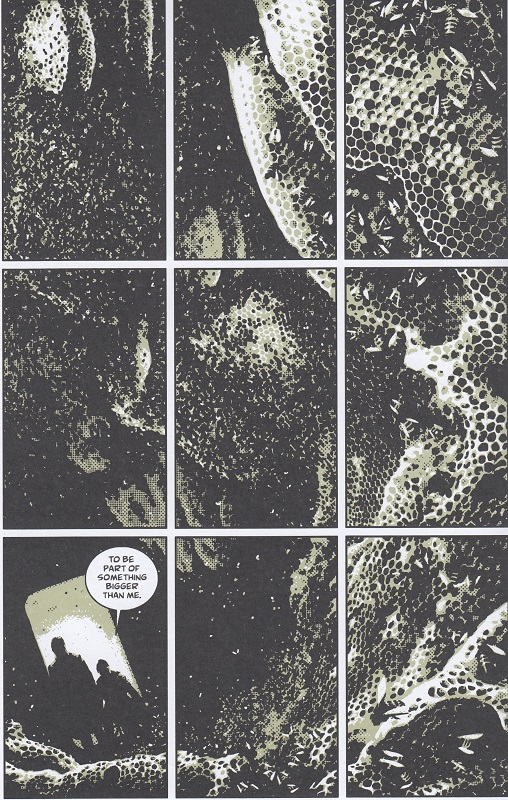
Originally intended as a 4-issue mini-series to be released under Dark Horse's short-lived Berger Books imprint, The Seeds released 2 issues in 2018, then vanished, only to appear as a complete TPB in 2020. Here's another review of the series I did 4 years ago.
Earth is dying, or at least that's what everyone seems to think. A billionaire tried shooting himself into space, missed his mark, and crashlanded on Enceladus. The people living inside the walls are dealing with frequent power blackouts and loss of wi-fi or communications networks. The people who moved outside the walls are living in the remains of what's out there, trying to get by without technology. At least, without wireless technology. Phones, Internet, things like that. They still have guns and the wheel and haven't abandoned agriculture. There's a quartet of aliens going around, gathering seeds and biological specimens. They hope the Earth is dying, because otherwise, the stuff they're collecting isn't worth anything.
But I think the point is that life is more resilient than we give it credit for. It's just that our particular notion of "life" isn't going to hold. Throughout the story, technology keeps failing, but life perseveres. There are two people, we only ever see them in hazmat suits. One is convinced their mechanical drone bees will handle pollinization, now that real bees are being killed by insecticides, pesticides mites. Specifically, pollenizing almond trees, because nuts are big money. The other is betting on things like planting wildflowers for the bees, or for fungi to repair ecological damage. At the end, the real bees have turned the drones into building fodder in their hives. The hives they built inside the tech acolyte's power junction boxes, messing them up in the process.
The quartet of aliens are used to dealing with single-celled life. Intelligent alien life (as intelligent as humans get, anyway) is a new thing for them, and it seems to mess with them. Race falls in love, or at least takes an interest in, a girl named Lola. Convinces her to move outside the walls, protects her from her cohorts. Eventually abandons the project. The leader of the quartet loses it, starts watching TV and shooting the sets with rifles. When a reporter named Astra publishes a photo of him and he becomes a star, he goes inside the walls the meet the people who find him interesting. By the end, none of the aliens seem to be making any plans to leave.
If they're actually aliens. There's a panel on the second-to-last page that suggests they may be lab-created by a biotech company, one that flew by earlier (flying over the no-tech zone) and sprayed stuff that killed the bees. The seeds aren't worth anything if the planet's still alive.
Aja draws a lot of nine-panel grids. Sometimes they're each showing individual things, but other times it's part of a larger picture, just broken up into smaller bits. There's also a recurring honeycomb motif, and in many cases, it's revealed by zooming in on something. Show a turtle, then zoom in on the design of the plates on its shell. Or zoom in on the wings of a fly, or an image on a phone screen until we're looking at a few pixels. The honeycomb design keeps popping up, suggesting a connection between living things, that we're not each just individual organisms, and technology is just humanity's best attempt at replicating life.

No comments:
Post a Comment